6.5 Condensation for horizontal tube
6.5.1 Condensation outside horizontal tube or bank of tube
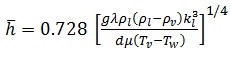
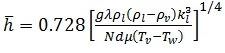
This type of condensation is very common especially for the shell and tube heat exchanger. In case of condensation outside the vertical array of horizontal tubes the condensate flows as a film along the cylindrical surface or it may drop down. In case of another tube below, the condensate film flows down from the bottom edge of the upper tube to the upper edge of the bottom tube. As it goes on to the lower tubes, the thickness of the condensate film increases. Some of the correlations are given below.
6.5.1.1 Condensation on a single horizontal tube
|
(6.13) |
6.5.1.2 Condensation on a vertical tube of N horizontal tubes
|
(6.14) |
6.5.1.3 Condensation inside a horizontal tube
Figure 6.5 shows the physical picture of the condensation inside a horizontal tube (like an open channel flow).
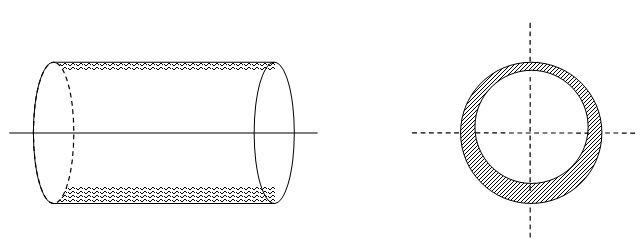
Fig. 6.5: Film condensation inside a horizontal tube
Case 1: The length is small or the rate of condensation is low.
This situation will have small thickness of the flowing condensate layer at the bottom of the tube and the following coefficient can be used,
|
(6.15) |
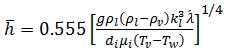
where, 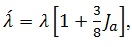 and the vapour Reynolds number (Rev) should be less than 35,000. The Rev is calculated based on inlet condition of vapour and inside diameter of tube.
Case 2: The length is high or the rate of condensation is high.
In this the following relation can be used.
|
(6.16) |
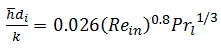
where,
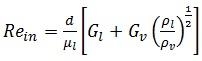
(Condition: Rel >5000, Rev > 20,000)
where, Gl and Gv are the liquid and vapour mass velocities calculated on the basis of the cross-section  of the tube.