Section PQ: In section PQ, initially when the wire temperature is slightly above the saturation temperature of the liquid, the liquid in contact with the heating surface get slightly superheated. The free convection of this heated fluid element is responsible for motion of the fluid, and it subsequently evaporated when it rises to the surface. This regime is called the interfacial evaporation regime.
Section QS: The section QS is composed of section QR and section RS. In QR section, bubbles begin to form on the surface of the wire and are dissipated in the liquid after detaching from the heating surface. If the excess temperature ( further increases, bubbles form rapidly on the surface of the heating wire, and released from it, rise to the surface of the liquid, and are discharged into the top of the water surface (fig 6.3). This particular phenomenon is shown in section RS. Near the point S, the vapour bubbles rise as columns and bigger bubbles are formed. The vapour bubbles break and coalesce thus an intense motion of the liquid occurs which in-turn increases the heat transfer coefficient or heat transfer flux to the liquid from the heating wire. The section QS is known as nucleate boiling.
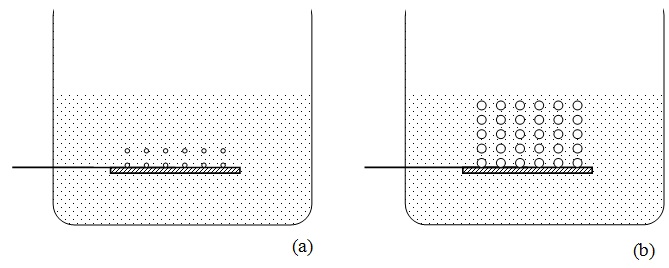
Fig. 6.3: (a) Formation of tiny bubbles, and (b) Grown up bubbles
Section ST: At the beginning of the section ST or at the end of the section , the maximum number of bubbles are generated from the heating surface. The bubbles almost occupy the full surface of the heating wire. Therefore, the agitation becomes highest as they discharge from the surface. Thus, maximum heat transfer coefficient is obtained at point S. However, once the population of the bubbles reaches to maximum, the nearby bubbles coalesce and eventually a film of vapour forms on the heating surface. This layer is highly unstable and it forms momentarily and breaks. This is known as transition boiling (nucleate to film). In this situation the vapour film (unstable) imparts a thermal resistance and thus the heat transfer coefficient reduces rapidly.
Section TU: If the excess temperature is further increased, the coalesced bubbles form so rapidly that they blanket the heating surface (stable vapour film) and prevent the inflow of fresh liquid from taking their place. The heat conducts only by the conduction through this stable vapour film. As a result the flux of heat transfer decreases continuously and reaches a minimum at point U. All the resistance to the heat transfer is imposed by this layer stable layer of vapour film.
Section UV: At very high excess temperature the heat transfer is facilitated by the radiation through the vapour film and thus the heat transfer coefficient start increasing. Infact the excess temperature in this regime is so high that the heating wire may get melted. This situation is known as boiling crises. The combine regime of ST, TU, and UV is known as film boiling regime.