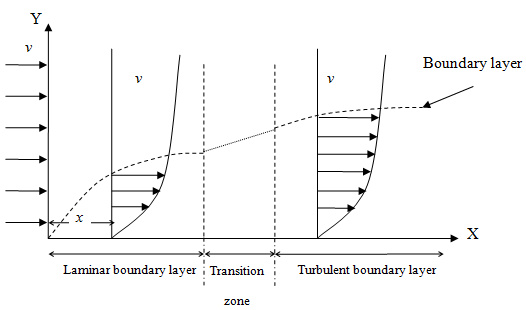
Fig.4.1. Boundary layer flow past a flat plate
The velocity profile merges smoothly and asymptotically in the free shear and the boundary layer thickness is difficult to measure. However, the theoretical laminar boundary layer thickness can be calculated using the eq.4.1.

where, Rex is the local Reynold number at a distance x. The derivative of δ can be found in any stated boundary.
The turbulent boundary layer thickness can be calculated using eq.4.2.

Figure 4.2 shows the velocity boundary layer for the turbulent and laminar zone.
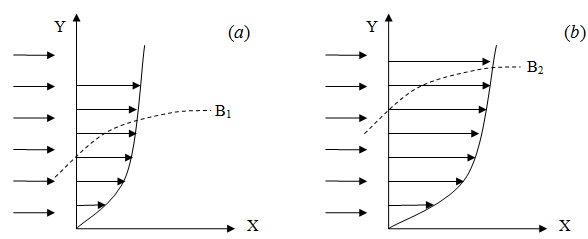
Fig.4.2: Boundary layer flow past a flat surface (a) turbulent, and (b) laminar
In continuation to the above discussion and understanding, if the solid surface is maintained at a temperature, Ts , which is different from the fluid temperature, Tf , measured at a point far away from the surface, a variation of the temperature of the fluid is observed, which is similar to the velocity variation described. That is, the fluid temperature varies from Ts at the wall toTf far away from the wall, with most of the variation occurring close to the surface.