3.3 Enhanced heat transfer: concept of fins
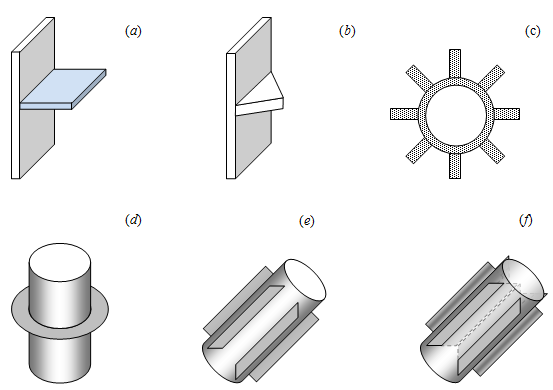
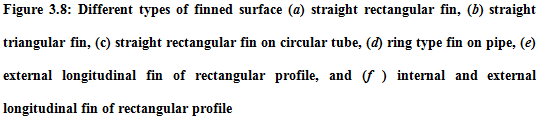
In the previous discussion, we have seen that the heat transfer from one fluid to another fluid needs a solid boundary. The rate of heat transfer depends on many factors including the individual heat transfer coefficients of the fluids. The higher the heat transfer coefficients the higher will be the rate of heat transfer. There are many situations where the fluid does not have a high heat transfer coefficient. For example, the heat lost by conduction through a furnace wall must be dissipated to the surrounding by convection through air. The air (or the gas phase in general) has very low heat transfer coefficient, since the thermal conductivities of gases are very low, as compared to the liquid phase. Thus if we make heat transfer device for gas and a liquid (of course separated by a heat conducting wall), the gas side film will offer most of the thermal resistance as compared to the liquid side film. Therefore, to make the heat transfer most effective we need to expose higher area of the conductive wall to the gas side. This can be done by making or attaching fins to the wall of the surface. A fin (in general) is a rectangular metal strip or annular rings to the surface of heat transfer. Thus, a fin is a surface that extends from an object to increase the rate of heat transfer to or from the environment by increasing convections. Fins are sometimes known as extended surface. Figure 3.7 shows photographs of an electric motor with the fins on the motor body and a computer processor with the fins to dissipate the generated heat into the environment. Figure 3.8 shows the different types of finned surfaces.
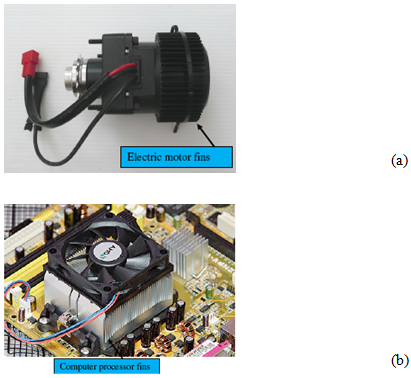
Fig. 3.7. Cooling fins of (a) electric motor, (b) computer processor