24.3 Pthalic Anhydride
24.3.1 Reactions
- • Basic raw material is Naphthalene or o-xylene.
• Naphthalene + O2 → Pthalic anhydride + H2O + CO2.
• O-Xylene + O2 → Pthalic anhydride + Water.
• Side reaction products: Maliec anhydride, Complete combustion products: CO2 and water.
• Catalyst: Vanadium pentoxide.
• Operating conditions: 340 - 385°C.
• Reaction is highly exothermic.
24.3.2 Process technology (Figure 24.2)
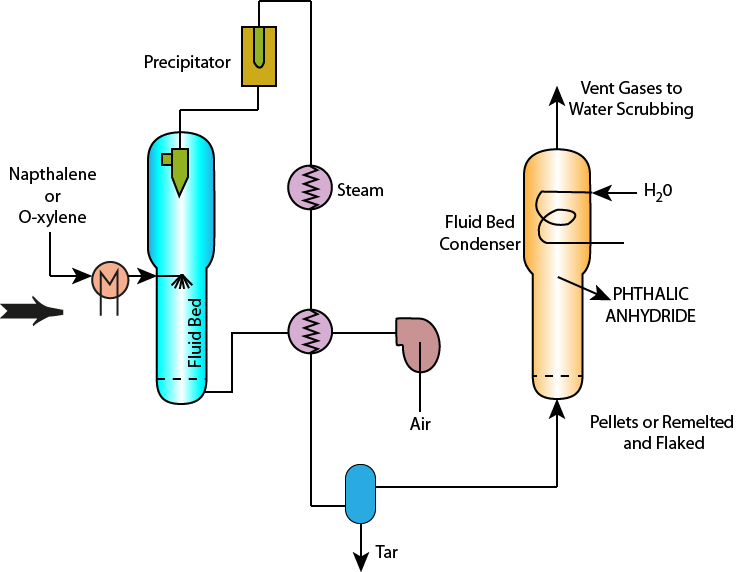 |
Figure 24.2 Flow sheet of manufacture of phthalic anhydride
In this lecture, we present the usage of both multitubular reactor or fluidized bed reactor for the production of pthalic anhydride.
While multitubular reactor is demonstrated for o-xylene, the fluidized bed reactor is demonstrated for naphthalene.
Ortho xylene to Pthalic anhydride (Fixed bed reactor)
- • Air is filtered and compressed to enter a air pre-heater
• O-xylene is also separately vaporized to generate the o-xylene vapour
• The o-xylene and compressed air enter a multitubular reactor. The reactor design is essentially a shell and tube set up where the catalyst is held in the tubes.
• Salt solution is circulated to cool the reactor in the shell side. The salt solution that gets heated up is sent to a waste heat recovery boiler to generate process steam.
Napthalene to Pthalic anhydride (Fludized bed reactor)
- • Napthalene and air are allowed to enter the fluidized bed. Napthalene in molten form is sprayed on to the fluidized bed of catalyst in air.
• The operating temperature is about 600°C in this case.
• Eventually, the vapors (+ catalyst dust) enter a cyclone unit to separate the catalyst particles and the vapors from the cyclone separator.
• The fluidized bed is supplemented with cooling tubes in which salt solution is circulated to eventually obtain steam from the waste heat recovery boiler.
• The fluidiized bed reactor does not provide higher yields of maleic acid.
Separation network (common for both fluidized bed reactor and packed bed reactor technologies)
- • The reactor effluent (vapour) is sent to a steam generator where the vapors are cooled to condense the pthalic anhydride and the boiler feed water is converted to steam. Here, pthalic anhydride is just cooled to a temperature slightly above its dew point.
• After cooling the pthalic anhydride, the condensed pthalic anhydride is sent to switch condensers that enable the generation of crude product. The switch condensers enable the generation of pthalic anhydride solid product.
• The condensers generate maleic anhydride and fumaric acid as the non-condensibles from the switch condensers.
• The crude product is subsequently melted, distilled and sent to a crystallization process or pellization process to obtain high purity product.
24.3.3 Uses :
Phthalic anhydride is used as a versatile intermediate in organic chemical reactions, mainly because it is bifunctional and is cheaply available. It may also be used in the manufacture of phathalate plasticizers like DOP, DEP etc.