10.3 Process technology (Figure 10.1)
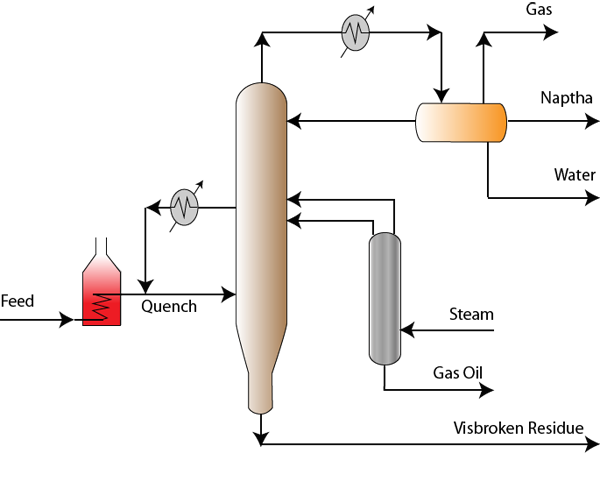
Figure 10.1 Coil Visbreaker
- • Visbreaking is carried out either in a coil or in a soaker.
• When coil technology is used, the mild thermal cracking is carried out in the furnace coils
• When soaker technology is adopted, the cracking is carried out in a soaker unit that is kept immediately after the furnace.
• After cracking, the products are at high temperatures (480 °C for coiled furnace case or 430 °C for the soaker)
• After cracking, the products are cooled using quenching operation.
• Quenching is a direct heat transfer mechanism in which a hot stream is cooled with a hydrocarbon or water to reduce the temperature of the system drastically.
• After quenching, the mixture is fed to a distillation column supplemented with a side column and a partial condenser.
• From partial condenser, water, naphtha and gas are produced. Naphtha liquid stream is sent as a reflux for the column.
• The side column is fed with steam and produces gas oil. Steam enhances hydrocarbon volatility as explained before in the lecture devoted towards crude distillation process.
10.4 Coking (Figure 10.2, 10.3)
- • Coking refers to extreme thermal cracking process.
• Coking is a batch reaction. Feed is heated to 480 – 510°C and left for some time so that coke and lighter products form.
• Since coking is a batch reaction, there can be different ways to carry out coking.
• There are two types of refinery coking processes namely delayed coking and fluid coking.
• Delayed coking: The heated feed is fed to a coke drum and coke forms in the drum. The lighter products are withdrawn from the top section of the delayed coker. After coking,the coke drum is full of coke and it is then removed using water jets . The process is called delayed coking because in this process the coal is heated using a much more complex system , and it consists of multiple furnaces or coke drums. Usually the coal is heated at a lower temperature for shorter periods of time , which removes water and other by – products more slowly than the conventional process, thereby increasing the overall time span.
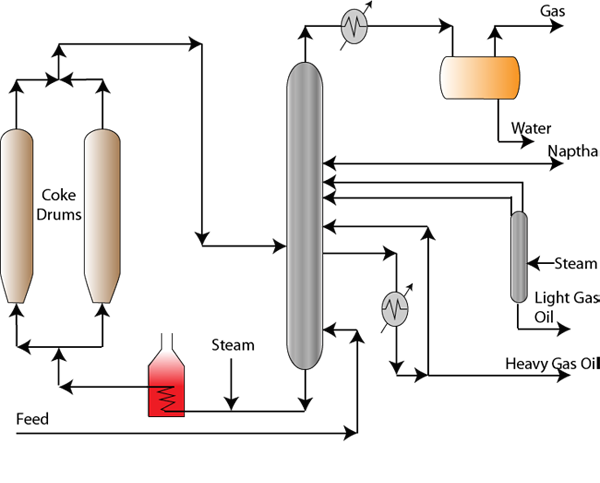
Figure 10.2 Delayed Coker
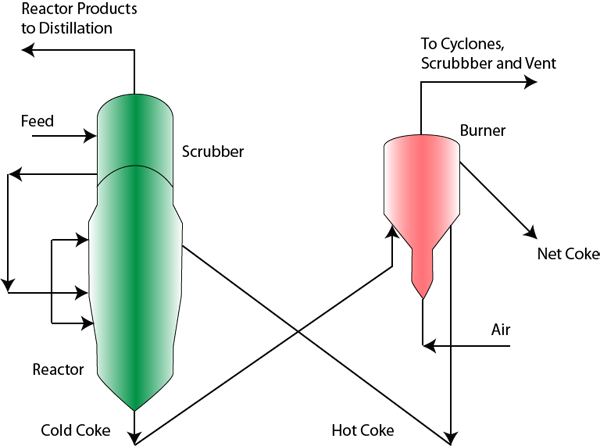
- • Fluid coking: The heated feed is fed to a fluidized bed where coke particles with finer particle sizes would aid fluidization. After coking, lighter products are withdrawn as overhead vapour and coke thus formed is removed continuously. The fluid coker also has an additional scrubber which will remove heavier compounds from the vapour (if any) and send them back with the feed stream. Here, the feed stream absorbs heavier hydrocarbons from the vapour generated. This is required as it is difficult to keep heavier hydrocarbons in the feed phase only due to pertinent high temperatures. The coke after coking reaction is cold coke. Therefore, to generate hot coke, a burner unit is used to heat the coke using exothermic CO2 reaction. The offgases from the burner are sent to cyclones, scrubbing and then to the vent. The hot coke thus obtained is recycled back to the fluidized bed or taken out as a net coke product.
-
-
Figure 10.3 Fluid Coking
- • The coker products are fed to a complex distillation column i.e., main column supplemented with side columns. From the complex distillation column, naphtha, water, light gas oil and heavy gas oil are obtained.
Additional complexities in the distillation unit are
1. Feed entering the distillation column but not the coker unit: This is to facilitate the removal of light ends from the feed (if any) and don’t subject them to cracking. This is also due to the reason that light ends are valuable commodities and we don’t want to loose them to produce cheap coke product. In this case, the bottom product from the distillation column is fed to the furnace for pre-heating and subsequent coking operation.
2. Live steam in distillation: This is to facilitate easy removal of lighter hydrocarbons in various sections.
3. Circulatory reflux (Pump around units): This is to facilitate good amount of liquid reflux in various sections of the main column. For Further details, of the above two issues, please refer to the crude distillation lecture notes.