· Energy balance for effect II:
 (3. 3)
Enthalpy values: reference temperature = 60 °C (temp of solution leaving effect II)
H1 = (112.6 - 60)(0.94 kcal/ kg °C)= 49.4 kcal/ kg
(Specific heat of the solution leaving the 1 st effect is taken as the mean value of the sp. heat of feed and the concentrated liquor, i.e.,  0.94)
0.94)
H2 = 0 kcal/ kg (w.r.t. the reference temperature of 60 °C)
λs1 = 531 kcal/ kg; λs2 = 563 kcal/ kg
∴ (8000 - ms1)(49.4) + ms1 (531) = (8000- ms1 - ms2)(0) + ms2 (563)
⇒ ms2 = 0.855 ms1 + 702.6 (3.C)
Solving Eqs. 3.A, 3.B and 3.C for ms, ms1 and ms2:
ms = 4713; ms1 = 3395 and ms2 = 3605 kg/ h
Areas:  ;
; 
The areas in the two effects are not equal. Revised calculation is required.
The revised temperature difference in 1st effect,  taken for the calculation (you may also continue the calculation with this revised value
 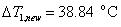 (3.13)
Temperature of the saturated vapor from the first effect = 148 -60= 108 °C
Corresponding evaporator drum pressure = 1.2116 bar
Latent heat of the vapor leaving the 1st effect at 108 °C= 530 kcal/ kg (λs1)
Corresponding pressure in the vapor drum = 1.3317 bar
Revised calculation: Energy balance for effect I (reference temperature 108 °C)
∴ (8000)(-72.6) + ms(506) = (8000- ms1)(0) + ms1(530) (3.2)
⇒ ms = 1.047 ms1 + 1075 (3.D)
Revised calculation: Energy balance for effect II (reference temperature 60 °C)
∴ (8000 - ms1)(0.94)(108-60) + ms1 (530) = (8000- ms1 - ms2)(0) + ms2 (563) (3.3)
⇒ ms2 = 0.8612 ms1 +641 (3.E)
Solving 3.A, 3.D and 3.E, ms= 4652; ms1= 3417 and ms2 = 3583 kg/ h
Areas:  ;
; 
These areas are fairly close, use A1= A2 = 104 m2 plus overdesign. About 10% excess area will provide a reasonable overdesign.