A. Two Step Probing: In two step probing scheme, membrane is first probed with the primary antibody to recongnize the protein of interest. (Generation of monoclonal or polyclonal antibody is discussed in the later lectures). Membrane is probed with the primary antibody with an appropriate dilution for 1hrs at room temp (RT). Membrane is washed with buffer containing non-anionic detergent Triton X-100 and reprobed with another antibody directed against the primary antibody. The secondary antibody is coupled with an enzyme (either HRP or alkaline phosphatase) or a fluorescent dye. Washed membrane is incubated with the secondary antibody with an appropriate dilution for 1hrs at room temp (RT). Membrane is washed with buffer containing non-anionic detergent Triton X-100 and developed. Use of two different antibodies increases sensitivity as well as giving flexibility to plan multiple probing.
B. One Step Probing: In one step probing, primary antibody contains enzyme or fluorescent label for detection. One step probing is not very common.
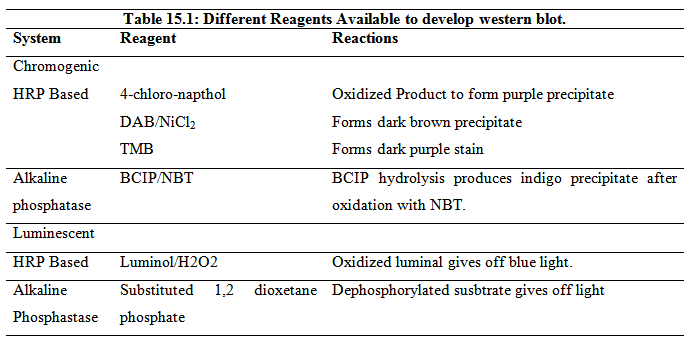
STEP 6: Blot Development : There are multiple ways to develop the blot and detect the protein present on the membrane. A list of reagents to develop blot are given in the Table 15.1.
A. Colorometeric Detection: The different colorimetric reagents are given in the Table 15.1. Wash the membrane with TBS to remove detergent. Place the membrane into the colorimetric reagent and protein bands appeared in 10-30mins. Stop the reaction by washing in distilled water. Air dry the membrane and photograph for permanent record.
B. Chemiluminescent Detection: The different chemiluminescent reagents are given in the Table 15.1. Transfer the membrane into the chemiluminescent reagent. Soak the membrane for 30sec to 5mins. Drain off the reagent and wrap the membrane into the plastic wrap. Place it in film cassette and expose the membrane to film for a few seconds to several hours.
C. Fluorescent detection: Secondary antibodies labeled with fluorescent dye and captured in the scanner.