2. Chloroplast- Chloroplasts are found in plant, algae and other lower invertebrates such as euglena. Contrasting to mitochondria, chloroplast has outer membrane, an inner membrane and then light pigment containing inner most thylakoid membrane (Figure 4.2, A). Outer membrane is porous to the small molecules but protein or large molecules are transported by TOC (translocon on the outer chloroplast membrane) complex. Movement of material passed through outer membrane gets into the inner membrane through TIC (translocon on the inner chloroplast membrane) complex. In between outer and inner membrane is intermembrane space filled with aqueous liquid.
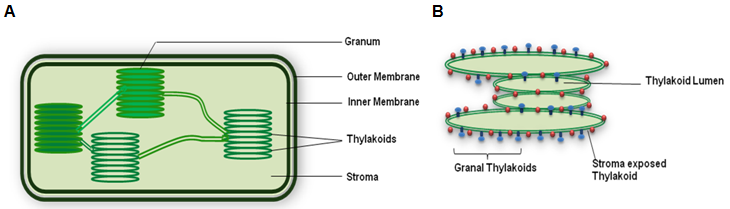
Figure 4.2: (A) Struture of Chloroplast, (B) Arrangement of thylakoid membrane in chloroplast.
The inner membrane of the chloroplast further folds to a flattend membrane system known as thylakoids . The photosynthsis machinery such as light absorbing pigments, electron carriers and ATP synthesizing machinery is present on inner membrane as intergral protein complex. Thylakoid membranes are arranged like stack of coin to form granum (Figure 4.2, B). The granum throughout the chloroplast are connected by tubule to share the material. Over-all structure of chloroplast is similar to mitochondria but it has few significant structural and biochemical differences. Thylakoid membrane contains photosynthetic green colored pigment chlorophyll.
 |
(4.1) |
Photosynthesis is an assimilation reaction involving CO2 and water to produce sugar in the presence of solar energy (photons) that catalyzes fusion reaction as given Eq. 4.1. The photo system present on thylakoid membrane consists of two photo system, photo system-I (PS-I) and photo system complex II (PS-II) . PS-II absorbs the photon from solar energy to excite the electron to the higher energy state, and catalyze water break down into the proton and oxygen. The electron pass through multiple electron carrier and during this proton are exported out of the thylakoid membrane into the lumen. The proton passes through ATP synthase and returns back into the stroma to generate ATP. The electron from PS-II is eventually been received by PS-I and been excited after absorbing photon from sun light to high energy state. The energy associated with these electrons are used to generate NADPH in the stroma. Hence as a result of photosynthesis, solar energy is trapped by photo synthesis apparatus to generate ATP and NADPH into the lumen. Both of them are used to run Calvin cycle to assimilate environmental CO2 to form sugar.