10.3 Knockout mice:
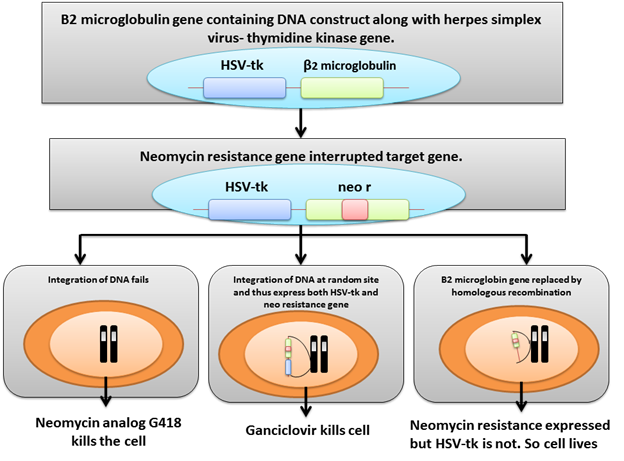
A mouse in which an endogenous gene has been modulated in such a way that its normal expression is altered is called knockout mice. The knockout mice are important in understanding the complex biological pathways, human embryonic developmental pathways, and gene therapy. The knockout models are made for a very specific gene of interest. Alteration of the gene takes place at a precise position using an embryonic pluripotent stem cell. Recombinant DNA vector containing the gene of interest is interrupted with an antibiotic resistance gene such as G418 (Figure 10.4). To ensure targeted integration has occurred, the flanking DNA contains the thymidine kinase gene (tk) from herpes simplex virus. There are three possibilities following the integration of the recombinant DNA:
- 1. Cells or embryo will die if they fail to integrate when grown in presence of neomycin and in absence of resistance gene.
2. The cells or embryo will die under Ganciclovir if the integration occurs at random site, since the expression of tk will kill it.
3. Cells and embryo will survive if the integration is site specific since the knocked out cells will survive both in G418 and Ganciclovir.
Figure 10.4 knockout mice generation: