31.4 Virus replication
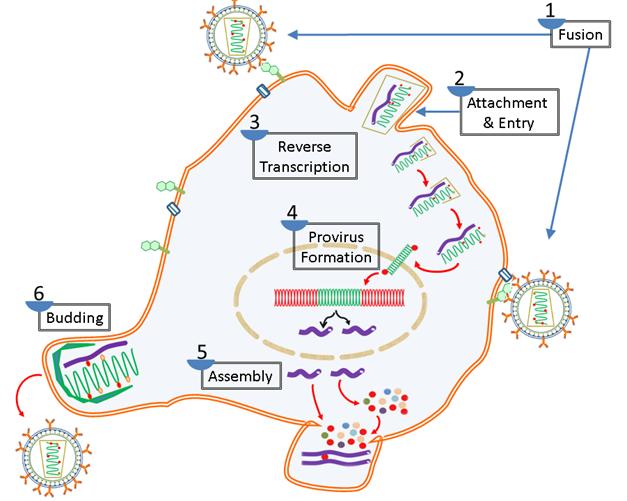
Many of our present days understanding about the retrovirus comes from the work of HIV. Upon entry to the cells, viral RNA produces a polyprotein which is cleaved by virus encoded proteases to form individual protein. Virus uses the tRNA as a primer to synthesize DNA using reverse transcriptase enzyme. RNA from the hetroduplex form of RNA and DNA is then cleaved by RNase H. The remaining part of DNA is synthesized as double stranded and integrates into the host cell genome with the help of enzyme integrase. The viral genome remains integrated into the host genome and keeps on transcribing the viral RNA for the progeny virions. The progeny virions are assembled in the cytoplasm and exit by the process of budding taking the covering of the host cell membrane.
Figure 31.1 Schematic representation of HIV replication:
31.5 Endogenous Retroviruses
Genome of many vertebrate animals contains retroviral sequences. These sequences are mostly inactive or defective. On an average a normal human cell contains approximately 1, 00, 000 retroviral sequences. It is likely that the retroviruses can infect the germ lines early in the life, giving rise to these sequences in the human genome.