Many immunological techniques are used regularly in the laboratories to assess the immune status of the individual or to diagnose the diseases. Generally all or most of these techniques require antibodies to complete the routine procedure. The specificity of an antibody for a particular antigen makes it a valuable tool for diagnostics and many other molecular biological techniques. The discovery and uses of monoclonal antibodies have revolutionized our current understanding of immunology.
39.1 Immunoassays
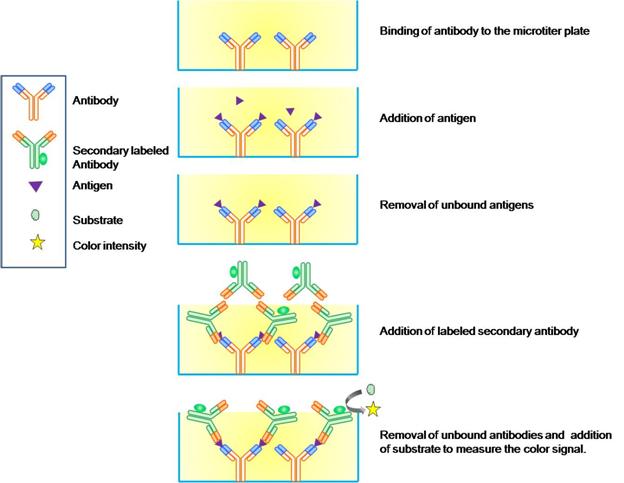
Quantification of the antigen is a valuable data in both basic and clinical research sciences. Immunochemical methods of antigen quantitation are usually based on reactivity of pure antigen and antibody with an indicator molecule. When the antigen or antibody is labeled with a radioisotope it can be quantified by the decay of radioactive element by the assay called Radioimmunoassay (RIA) . When the antigen or antibody binds with an enzyme, it can be quantified by spectrophotometer reading upon conversion of substrate into a color by the enzyme, the assay is called an enzyme-linked immunosorbent assay (ELISA) . Many forms of RIA and ELISA exist but the most commonly used one is the sandwich method in which two different forms of antibodies are used against different areas of an antigen. Briefly, a known quantity of antibody is attached to the solid support in a microtiter plate. The antigens to be tested are used in different concentration along with a known concentration of control antigens and are allowed to react. The unbound antigens are washed with the appropriate solution and an enzyme linked or radiolabeled second antibody is added to react with the complex. The results from the standard solutions are used to construct the standard curve and accordingly the quantification of the test antigen is completed.
Figure 39.1 Schematic representation of an enzyme-linked immunosorbent assay: