7.2.1 Uses of monoclonal antibodies
1) Monoclonal antibodies help in immunodiagnosis by detection of a particular antigen or antibody.
2) Many tumor-specific antibodies help in tumor detection.
3) Some of the monoclonal antibodies have therapeutic uses. E.g. cytokine tumor necrosis factor (TNF) is used to treat many inflammatory conditions.
4) Monoclonal antibodies help in identification of individual cell populations e.g. lymphocyte and leukocyte differentiation has become possible now.
5) They help in the purification of cells in order to generate the info about their features and functions.
7.3 Genesis of immunoglobulin (Ig) molecules
Like most of the proteins, immunoglobulin heavy and light chains are formed in the rough endoplasmic reticulum. Chaperones are the proteins that are required for proper folding or unfolding of Ig heavy chains and also are needed during the assembly of heavy chain with light chain. Assembly process includes stabilizing of both the heavy and light chains by disulfide linkage and mutual association of heavy and light chains and the whole process occurs in endoplasmic reticulum. This is followed by carbohydrate modification which is required at the end of assembly process. At the end of this process Ig molecules get separated from chaperones and are shifted to cisternae of Golgi complex for carbohydrate modification, and finally find the way into the plasma membrane in vesicles. Membrane bound Ig molecules lie within the plasma membrane and the secreted form find its way out of the cell.
Membrane form of the µ heavy chain is synthesized by a prototype called the pre-B cell, which synthesizes the Ig polypeptides. Pre- B cell receptor expression on cell surface requires the association of µ heavy chain with surrogate light chains. Further maturation of B- cells is associated with modification in Ig gene expression leading to the generation of Ig molecules in different forms. The mature B lymphocytes differentiate into the antibody- secreting cells only when stimulated by foreign object or any antigen.
7.4 Half- life of antibodies
Half-life of antibodies varies in circulation. IgG molecules have a half life of 21 to 28 days while IgE has the shortest half-life of about 2 days. Long half-life of IgG is assigned to its ability to bind to Fc receptor called the neonatal Fc receptor. It is neonatal Fc receptor that is responsible for transfer of maternal IgG across the placental barrier.
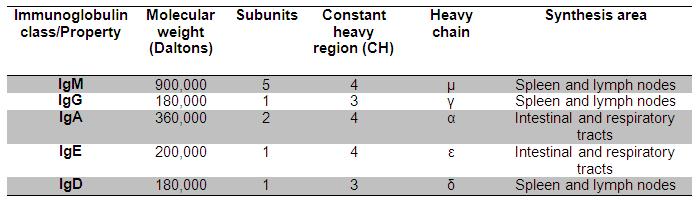
Table 7.1 Biological properties of different Ig molecules: