PCR-an exponential cycle:
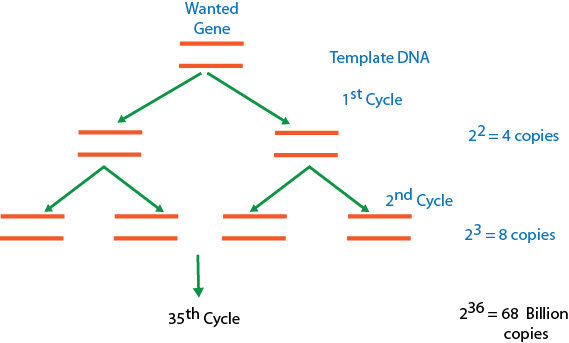
As both strands are copied during PCR, there is an exponential increase of the number of copies of the gene as shown in the figure. Suppose there is only one copy of the desired gene before the PCR starts, after one cycle of PCR, there will be 2 copies, after two cycles of PCR, there will be 4 copies. After three cycles there will be 8 copies and so on.
Primers design
Primers should bind to template with good specificity and strength. If primers do not bind to correct template, wrong sequence will get amplified. Optimal primer sequences and appropriate primer concentrations are essential for maximal specificity and efficiency in PCR. PCR specificity and efficiency can be greatly affected by the way primers are designed and used. Even when primers are designed to have similar annealing properties, the PCR may yield nonspecific PCR products (undesired DNA segment amplified), low amounts of specific product, or fail completely.
• Complementary nucleotide sequences within a primer and between primers should be avoided. If there are complimentary sequences in two primers used (one primer for each DNA strand), the primers will hybridize with each other thus forming primer-dimmers and will not be available for binding with template. If there are complementary sequences within a primer, it will make hairpin loop structures as shown below.
|

