1. Denaturation at 94°C :
During the heating step (denaturation), the reaction mixture is heated to 94°C for 1 min, which causes separation of DNA double stranded. Now, each strand acts as template for synthesis of complimentary strand.
2. Annealing at 54°C :
This step consist of cooling of reaction mixture after denaturation step to 54°C, which causes hybridization (annealing) of primers to separated strand of DNA (template). The length and GC - content (guanine-cytosine content) of the primer should be sufficient for stable binding with template. Please recall our discussion about DNA structure during earlier lectures. G uanine pairs with cytosine with three hydrogen bonding adenine binds with thymine with two hydrogen bonds. Thus, higher GC content results in stronger binding. In case GC content is less, length may be increased to have stronger binding (more number of H bonding between primer and template).
3. Extension at 72°C :
The reaction mixture is heated to 72°C which is the ideal working temperature for the Taq polymerase. The polymerase adds nucleotide (dNTP's) complimentary to template on 3' −OH of primers thereby extending the new strand.
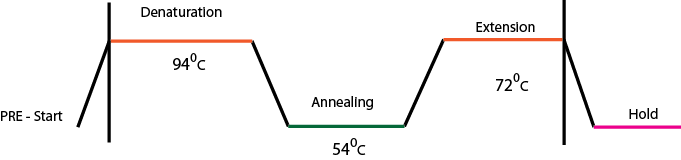
4. Final hold :
First three steps are repeated 35-40 times to produce millions of exact copies of the target DNA. Once several cycles are completed, during the hold step, 4−15 °C temperature is maintained for short-term storage of the amplified DNA sample.
|

