Basics of DNA Cloning-I
Basics of DNA Cloning will be covered in two lectures during this course.
Download this lecture
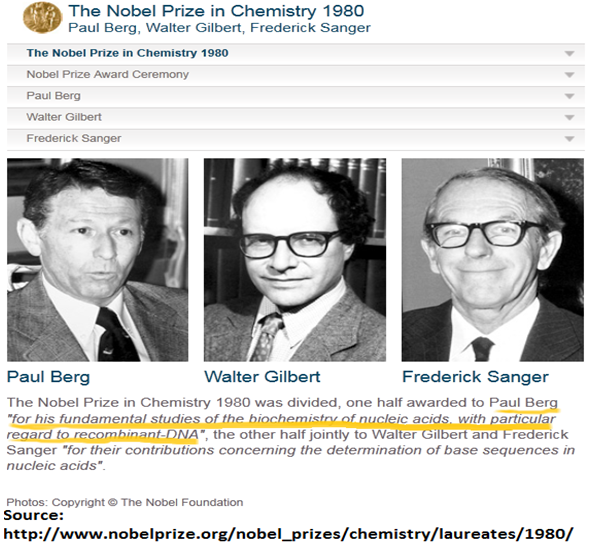
Cloning is making of identical copies. DNA cloning is process of making several identical copy of a gene or gene fragment. DNA fragment from an organism is cleaved or amplified and inserted in a DNA carrier called vector. Vectors are generally double stranded closed circular DNA which has origin of replication through which they can replicate in the host system. Vectors also have a selectable marker (generally antibiotics resistance gene) for screening of recombinant colonies. Vector with desired DNA insert is called recombinant DNA. This can be transferred to suitable host system (generally E.Coli ) where it finds machinery for replication and makes several copies of it (may also express protein). The process is also called recombinant DNA technology or genetics engineering. Recombinant DNA technology is largely based on the work of Paul Berg, Herbert W. Boyer and Stanley N. Cohen although many other scientists have also made important contributions. Paul Berg in 1972, isolated a gene from a human cancer-causing monkey virus (SV40) using a restriction enzyme and joined this virus DNA with a molecule of DNA from the bacterial virus lambda using an enzyme called DNA ligase. This way the first recombinant DNA molecule was created. Later on, in 1980, Paul Berg shared Nobel prize in Chemistry for the work.
A simplified concept of cloning is given in Fig. 1.
|
