i) N-linked glycosylation- It takes place in the ER and continues in the golgi body. Here the carbohydrate moiety is attached to the amide group of the asparagine residue when it is present in the sequence NXS/T where, N is asparagine, X is any amino acid other than proline, S/T stands for serine/threonine residue. N-acetyl glucosamine (NAG) is the first residue transferred to the protein with the aid of an enzyme called N-acetyl glucosamine transferase (Fig. 4). Based on the structure of the carbohydrate moiety attached, N-linked glycosylation can be classified into three groups −
a) High mannose- Where beyond the core structure of carbohydrates which is common to all the three groups, mostly mannose residues are present.
b) Hybrid type- Here beyond the core structure along with mannose other residues are present like glucose, galactose and N acetyl glucosamine.
c) Complex- Beyond the core structure few complex carbohydrate residues are present such as sialic acid.
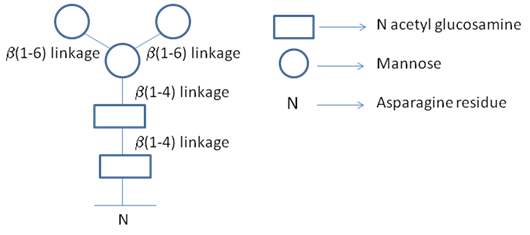
Figure 4: Core structure of carbohydrate moiety in N-linked glycosylation.
iii) O-linked glycosylation- Unlike N-linked glycosylation, O-linked glycosylation takes place exclusively in the golgi body. Here the carbohydrate moiety is attached to the hydroxyl group of serine, threonine or hydroxylysine residue. Unlike N-linked, it does not require any sequence and occur randomly. There is also no specific core structure of carbohydrates in O-linked glycosylation, any carbohydrate groups can be attached.
|

