2.4.2. Soxhlet extraction:
Soxhlet extraction is only necessary where the preferred compound has a limited solubility in a solvent, and the impurity is insoluble in that solvent. If the preferred compound has a high solubility in a solvent then a simple filtration procedure can be used to separate the compound from the insoluble substance. The benefit of this system (Figure 33.1) is that instead of many portions of warm solvent being passed through the sample, just one batch of solvent is recycled. This method cannot be used for thermolabile compounds as prolonged heating may lead to degradation of compounds.
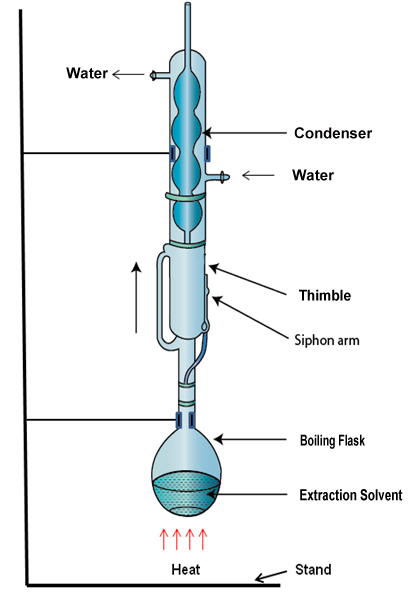
Figure 33.1: A Soxhlet apparatus
2.4.3. Maceration:
In maceration (for fluid extract), whole or coarsely powdered plant-drug is kept in contact with the solvent in a container with stopper for a defined period with frequent agitation until soluble matter is dissolved. This method is best suitable for use in case of the thermolabile compounds.
2.4.4. Decoction:
This method is used for the extraction of the water soluble and heat stable constituents from crude drug by boiling it in water for 15 minutes, cooling, straining and passing sufficient cold water through the drug to produce the required volume.
2.4.5. Percolation:
This is the procedure used most frequently to extract active ingredients in the preparation of tinctures and fluid extracts. A percolator (a narrow, cone-shaped vessel open at both ends) is generally used. The solid ingredients are moistened with an appropriate amount of the specified menstruum and allowed to stand for approximately 4 h in a closed container, after which the mass is packed and the top of the percolator is closed. Additional menstruum is added to form a shallow layer above the mass, and the mixture is allowed to macerate in the closed percolator for 24 h. The outlet of the percolator then is opened and the liquid contained, therein, is allowed to drip slowly. Additional menstruum is added as required, until the percolate measures about three-quarters of the required volume of the finished product. The marc is then pressed and the expressed liquid is added to the percolate. Sufficient menstruum is added to produce the required volume, and the mixed liquid is clarified by filtration or by standing followed by decanting.
2.4.6. Sonication
The procedure involves the use of ultrasound with frequencies ranging from 20 kHz to 2000 kHz. This increases the permeability of cell walls and produces cavitations. Although the process is useful in some cases, like extraction of Rauwolfi root, its large-scale application is limited due to the higher costs. One disadvantage of the procedure is the occasional but known deleterious effect of ultrasound energy (more than 20 kHz) on the active constituents of medicinal plants through formation of free radicals and consequently undesirable changes in the drug molecules.
2.5. Steps involved in the extraction
For extraction from plant explants, most important steps are size reduction, extraction, filtration, concentration and drying.