4.1. Signal recognition by Agrobacterium spp.
The wounded plant cells release certain chemicals, such as phenolics and sugars. These chemicals are recognized by Agrobacterium as signals. This in turn results in a sequence of biochemical events in Agrobacterium that helps in transfer of T-DNA of Ti plasmid.
4.2. Attachment to plant cell
Attachment of this bacterium to plant cells is a two step process. It involves an initial attachment via a polysaccharides (the product of att R locus). Subsequently, a mesh of cellulose fibres is produced by Agrobacterium. Several chromosomal virulence genes (chv genes) are involved in attachment of bacterial cells to the plant cells.
4.3. Induction of virulence gene
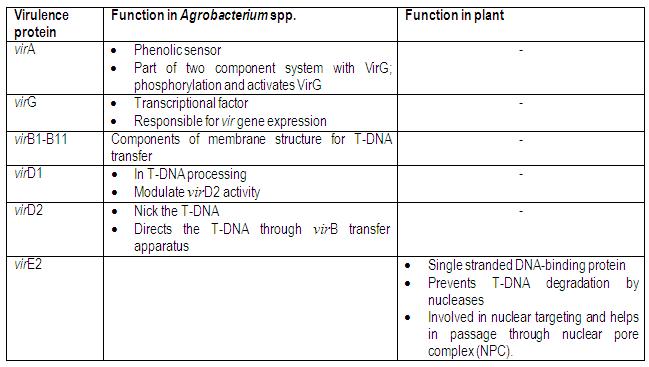
vir A (a membrane-linked sensor kinase) senses phenolics (such as acetosyringone) and autophosphorylates, subsequently phosphorylating and, thereby, activating vir G. This activated vir G induces expression of virulence gene of Ti plasmid to produce the corresponding virulence proteins (D, D2, E2, B). It has been also identified that certain sugars (e.g. glucose, galactose, xylose etc.) also induce virulence gene.
Table 25.1: Agrobacterium virulence protein function