1. Introduction
Plant histology is the branch of biology concerned with the composition and structure of plant tissues in relation to their specialized functions. Its aim is to determine how tissues are organized at all structural levels, from cells and intercellular substances to organs. It provides a realistic interpretation of morphology, physiology, and phylogeny of the structure of cells and tissues. A variety of techniques are used for histological studies by using various fixatives, stains, the use of microtome for preparing thin sections, light microscopy, electron microscopy, and X-ray diffraction.
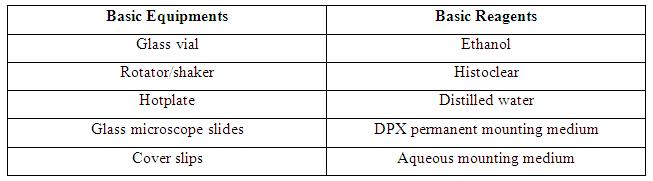
To study tissues, the specimen is generally sliced into thin sections then contrast within tissues is induced using dyes, heavy metals, or fluorochromes. Specific staining is obtained by using a dye which has an affinity for a particular cell type or tissue element, or by the use of specific probes, such as labelled antibodies or labelled RNA or DNA probes. The basic requirements of histological studies are listed in Table 20.1.
Table 20.1: Basic equipments and reagents required for histology