Therefore,
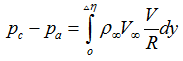
We have to change the limits of this integration since integration is with respect to y. Therefore we have to express ∆η (shock layer thickness) in terms of y co-ordinate. Here we are considering a very thick stream tube in the freestream by increasing dy, such that it extends from the stagnation streamline till point c. Therefore the lower limit of integration will still be zero and upper limit will be y co-ordinate of point c.
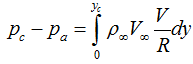
Since  , so,
, so,
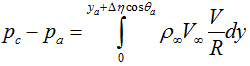
If we assume 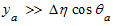 then,
then,
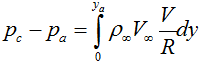
We know that tangential component of velocity is conserved across the shock hence this is the velocity which should be considered for balancing of centrifugal force with pressure. Therefore lets take V = V∞cosθ and R as constant,
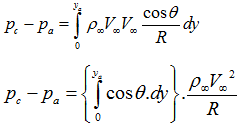 |
10.3 |
Here we can express the radius of curvature (R) in terms of known parameters as,
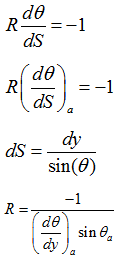
Using this expression , we can re-write the Eq. 10.3 as,
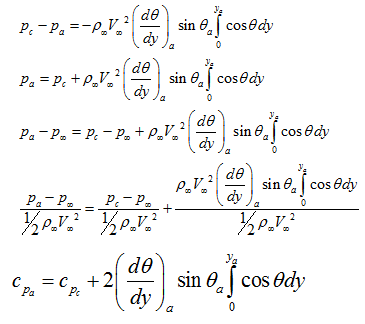 |
10.4 |
This is the final expression for pressure coefficient using Newtonian-Bwemann theory which is valid for 2D objects.
Some basic features of this theory are
- It accounts for centrifugal force
- It assumes small shock layer thickness as compared with body radius
- It does not predict the pressure well, hence not advisable in general.
- It is not truly local indication method since depends on upstream angles (in integration)

Among all three Newton’s methods
- Direct Newton’s method is more suitable for slender bodies like wedged or cones
- Modified Newton’s method is suitable for blunt bodies.
- Newtonian Busmann theory with centrifugal effect is not practically useful