In the above expression, observe that 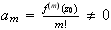 . If we set
  then
then  is analytic at
  and
and  such that
  . Thus, the function
  has a zero of order
  at
at  if and only if
  can be written as
  where
where  is analytic at
  and
and  .
.
If  is a non-constant analytic function in a neighborhood
  of a point
  and if
  then there exists a punctured disk
  for some
  such that
  is analytic in
  and
and  for all
  . This shows that zeros of nonconstant analytic functions are isolated . If the zeros of an analytic function
  is not isolated then
  will be either identically equal to
  or it will not be analytic at the limit point of the zeros of
  . It is summarized as follows:
Theorem: Let  be a connected open set and let
  be an analytic function in
  . Then, the following statements are equivalent.
1.
 .
.
2.
There is a point  such that
  for each
  .
.
3.
The set  has a limit point in
  .
.