Definition (Curve): A curve  is a continuous complex valued function
  defined for
  in an interval of the real line.
Examples: The semi circle  for
for ![$t \in [0, \; \pi]$](graphics/maths3_module4__52.png) is a curve in the complex plane. The straight line segment joining two distinct points
is a curve in the complex plane. The straight line segment joining two distinct points  and
and  is given by
  for
for ![$t \in [0, \; 1]$](graphics/maths3_module4__56.png) is also an example for a curve in the complex plane.
is also an example for a curve in the complex plane.
Definition (Simple Curve): A curve  (
(  ) is said to be a simple curve if
  for
for 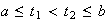 . That is, simple curve is a curve that does not intersect itself (except for end points).
Examples: The circle  for
for ![$t \in [0, \; 2\pi]$](graphics/maths3_module4__62.png) and the straight line segment
and the straight line segment  for
for ![$t \in [0, \; 1]$](graphics/maths3_module4__64.png) are simple curves in the complex plane. Whereas, any curve of shape of the number
are simple curves in the complex plane. Whereas, any curve of shape of the number  is not a simple curve.
Definition (Closed Curve): A curve  (
(  ) is said to be a closed curve if
  .
.
Examples: The circle  for
for ![$t \in [0, \; 2\pi]$](graphics/maths3_module4__70.png) is a closed curve. The oriented boundary of a rectangle or a triangle are closed curves.
is a closed curve. The oriented boundary of a rectangle or a triangle are closed curves.
Definition (Simple Closed Curve or Jordan Curve): A curve  (
(  ) is said to be a simple closed curve or Jordan curve if
  and
and  for
for 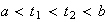 .
.