1. Find the values of  which make the function
  (a) purely real and (b) purely imaginary.
2. Prove that  where
where  denotes the imaginary part of
  . Deduce that
  tends to
  as
as  .
.
(Note that  is an unbounded complex-valued function of a complex variable whereas
  for
for  is a bounded real-valued function of a real variable.).
3.Find all solutions of  .
.
4. Describe the image of the following sets in the  -plane under the mapping
  .
.
(i) 
(ii) 
(iii) 
(iv) 
(v) 
(vi) 
(vii) 
(Note that mappings by  ,
,  and
and  closely related to the
  function are easily obtained once mappings by the sine function are known. Because,
 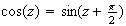 ,
,  and
and  and they are the same as the sine transformation preceded by translation or rotation.
5. Evaluate the following:
(i) 
 (ii)
(ii) 
 (iii)
(iii) 
6. Determine the domain of analyticity for the function 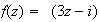 and compute
  .
.
7. Find the principal branch of the function 