A ray of light from the medium 1 incident on the interface making an angle of incidence  with normal partially gets reflected at the angle of reflection being equal to the angle of incidence and partially refracted at an angle of incidence
  fowling the Snell's law given by
 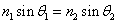 .
.
2. Reflection and the transmission coefficient as a function of angle of incidence
The amount of light reflected and refracted or transmitted depends on the optical property of the medium viz; refractive index, direction of electric field and the angle of incidence.
The direction of electric field is always perpendicular to the direction of propagation of the wave. If a wave is traveling in a certain plane the electric field vector could be in two mutually perpendicular planes which are normal to the direction of propagation. For example if the wave is propagating along z direction the electric field can be in the z-x (or z-y) plane or in x-y plane (or could be in both these planes; randomly polarized) but always perpendicular to the direction of propagation.