|
Bernoulli's equation is a product of general work energy theorem in fluid flow. According to this theorem, the work done by the resultant force acting on a system is equal to the change in kinetic energy of the system.
For the derivation of Bernoulli's theorem, the fluid flow is considered as ideal with following conditions. The fluid flow should be steady, incompressible, irrotational and non-viscous. Consider the flow of fluid through a portion of pipe as shown in Fig. 9.
The left side horizontal portion of the pipe is at an elevation of y1 and at the right side its elevation is y2. Let A1 and A2 be the area of cross sections of the pipe at the left and right end respectively.
|
|
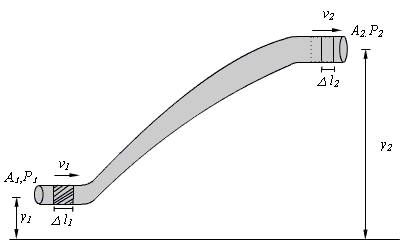
Fig. 9: Portion of the fluid moving from one end to other end
|