 |
The integration over  gives gives  . Using the expressions for . Using the expressions for  and and  in terms of the variable in terms of the variable  , we get, for the flux , we get, for the flux 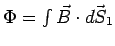
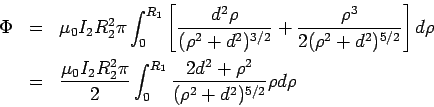
The integration can be easily performed by substituting  . After a bit of an algebra one gets . After a bit of an algebra one gets
![\begin{displaymath}\Phi = -\frac{\mu_0I_2R_2^2\pi}{2}\left[ (\rho^2+d^2)^{-1/2}+\frac{d^2}{3} (\rho^2+d^2)^{-3/2}\right]_0^{R_1}\end{displaymath}](../main3_clip_image046_0005.gif)
On substituting the limits and using a binomial expansion to retain leading order term when  , we get , we get
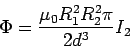
which gives the same expression for mutual inductance as in the previous example. |
