 |
Once the integration is carried out, the expression above can be shown to be symmetrical between the two circuits. To show, we express the vector triple product

so that
![\begin{displaymath}\vec F = \frac{\mu_0}{4\pi}I_1I_2\left[ \oint\oint\frac{\vec{... ...\frac{\vec{r_{12}}(\vec{dl_1}\cdot\vec{dl_2})}{r_{12}^3}\right]\end{displaymath}](../main3_clip_image103.gif)
The integrand in the first integral is an exact differential with respect to the integral over  as as 
The integral above being an integral of a gradient over a closed path vanishes. Thus
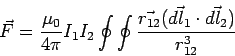
which is explicitly symmetric between the two circuits, confirming the validity of Newton 's third law. |
