REDUCTION OF ADDITIVE RANDOM NOISE
The model of an image degraded by additive random noise is given by
 |
(6.2.7) |
where  represents the signal-independent additive random noise. Examples of additive random noise degradation include electronic circuit noise, and in some cases amplitude quantization noise. In this section, we discuss a number of algorithms that have been proposed for reducing additive random noise in images. represents the signal-independent additive random noise. Examples of additive random noise degradation include electronic circuit noise, and in some cases amplitude quantization noise. In this section, we discuss a number of algorithms that have been proposed for reducing additive random noise in images.
Wiener Filtering
One of the first methods developed to reduce additive random noise in images is based on Wiener filtering .
The Noncausal Wiener Filter
Suppose we have a signal  and a noise and a noise  which are samples of zero-mean stationary random processes which are samples of zero-mean stationary random processes  and and  . The noisy observation . The noisy observation  is given by is given by
 |
(6.2.8) |
We wish to determine  from from  using a linear estimator given by using a linear estimator given by
 |
(6.2.9) |
The linear estimator is an LSI system, since we are dealing with stationary random processes. The error criterion used is.
Error 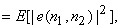 |
(6.2.10a) |
 |
(6.2.10b) |
where  denotes the estimate of denotes the estimate of  . This is called a linear minimum mean square error estimation problem, since we are using a linear estimator and minimizing the mean squared error between . This is called a linear minimum mean square error estimation problem, since we are using a linear estimator and minimizing the mean squared error between  and and 
This signal estimation problem can be solved by using the orthogonality principle. This principle states that the Error in (6.2.10) is minimized by requiring that  be uncorrelated with any random variable in be uncorrelated with any random variable in  . From the orthogonality principle, . From the orthogonality principle,
| |
=  |
|