A Posteriori determination of PSF
If the degradation is of an unknown nature or if the phenomenon underlying the degrading is too complex for the analytical determination of  , the only possible alternative is to estimate it from the degraded picture itself. For eg. if there is any reason to believe that the original picture or scene contains a sharp point, then the image of that point in the degraded picture is the PSF.This would be the case in an astronomical picture where the image of a faint star can be used as are estimate of PSF. , the only possible alternative is to estimate it from the degraded picture itself. For eg. if there is any reason to believe that the original picture or scene contains a sharp point, then the image of that point in the degraded picture is the PSF.This would be the case in an astronomical picture where the image of a faint star can be used as are estimate of PSF.
If the original scene contains sharp lines then it is sometimes possible to delete  from images of these lines. from images of these lines.
To show how this can be done, let us assume an ideal line source parallel to x-axis in the original scene.
The image of a line source is denoted by  where we can regard where we can regard  as a function of two variables x and y , which is independent of x. as a function of two variables x and y , which is independent of x.
From this view point  can be regarded as a line source parallel to x- axis can be regarded as a line source parallel to x- axis
Using the sifting property of  i.e. i.e.
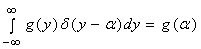
We have
We can change the variables of  from from  to to  and we see that and we see that
 . .
As  is a function of y alone we can write as is a function of y alone we can write as 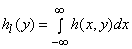
In other words the image of a line source is constant in the direction along the line and its dependence on the perpendicular direction is given by integrating the PSF along the line. It is clear that if PSF is not circularly symmetric, then the image of a line source depends on the orientation of the line .
Let
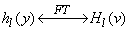 then then 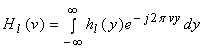
Now, 
If we substitute u=0 in this example we obtain,

This shows that if the image of a line parallel to x-axis is Fourier transformed, the result gives the value of transformation function
 along line u=0 in the uv - plane. along line u=0 in the uv - plane. (continued in the next slide) |