Reduction of Blurring and Additive Random Noise
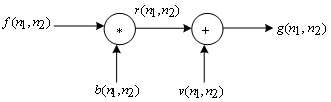
In the previous two sections, we developed image restoration algorithms to reduce blurring and additive random noise separately. In practice, an image may be degraded by both blurring and additive noise.
 |
(6.5.1) |
This is shown in Figure 6.14
| Figure 6.14 Model of image degradation by blurring and additive random noise |
From (6.5.1), one reasonable approach to restoring  is to apply a noise reduction system to estimate is to apply a noise reduction system to estimate  from from  and then to apply a deblurring system to estimate and then to apply a deblurring system to estimate  from the estimated from the estimated  , as shown in Figure 6.15. , as shown in Figure 6.15.
| Figure 6.15 Reduction of blurring and additive random noise by cascade of a noise reduction system and a deblurring system |
The approach of reducing one degradation at a time allows us to develop a restoration algorithm for each type of degradation and simply combine them when more than one type of degradation is present in the degraded image. In addition, it is an optimal approach in some cases. For example, suppose  and and  are samples of zero-mean stationary random processed that are linearly independent from each other. In addition, suppose are samples of zero-mean stationary random processed that are linearly independent from each other. In addition, suppose  is known. Then the optimal linear estimator that minimizes is known. Then the optimal linear estimator that minimizes  is an LSI system with a frequency response is an LSI system with a frequency response  given by given by
 |
(6.5.2) |
Equation (6.5.2) can be derived in a manner analogous to the derivation of the Wiener filter in Section 6.1.4. Equation (6.5.2) can be expressed as
 |
(6.5.3) |
The expression  is noise reduction system by Wiener filtering. The system estimates is noise reduction system by Wiener filtering. The system estimates  from from  . The expression . The expression  is the inverse filter, which estimates is the inverse filter, which estimates  form the estimated form the estimated  . The overall system is thus a cascade of a noise reduction system and a deblurring system. This is shown in Figure 6.16. . The overall system is thus a cascade of a noise reduction system and a deblurring system. This is shown in Figure 6.16.
| Figure 6.16 Cascade of a wiener filter for reduction of random noise and an inverse filter for reduction of blurring |
Figure 6.17 illustrates the performance of the image restoration system when an image is degraded by blurring and additive noise. Figure 6.17(a) shows an original image of 512 x 512 pixels. Figure 6.17(b) shows the original image blurred by a Gaussian-shaped point spread function and then degraded by white Gaussian noise at an SNR of 25dB. Figure 6.17(c) shows the image processed by the noise reduction system. The result of inverse filtering alone without noise reduction is shown is Figure 6.17(d). It is clear that inverse filtering is sensitive to the presence of noise.
|