Algorithms for Blind Deconvolution
The function  and and  for this particular example are shown in Figures 6.13(f) and (g). Suppose we apply a smoothing operator S to (6.3.14). Assuming the smoothing operating S is linear, we have for this particular example are shown in Figures 6.13(f) and (g). Suppose we apply a smoothing operator S to (6.3.14). Assuming the smoothing operating S is linear, we have
 |
(6.4.15) |
Since both  and and  are smooth functions, smoothing will not affect are smooth functions, smoothing will not affect  significantly. From Figure 6.20(g), however, smoothing will reduce significantly. From Figure 6.20(g), however, smoothing will reduce  significantly. Based of this observation, (6.4.15) reduces to, significantly. Based of this observation, (6.4.15) reduces to,
 |
(6.4.16) |
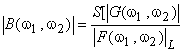
From (6.4.16)
 |
(6.4.17) |
Equation (6.4.17) is the basis for estimating  . The numerator term . The numerator term  can be determined from the blurred image can be determined from the blurred image  . The denominator term . The denominator term  is approximately the same for similar classes of images. Differences in the image details affect is approximately the same for similar classes of images. Differences in the image details affect  , but they do not appear to significantly affect , but they do not appear to significantly affect  . Based on this observation, . Based on this observation,
 |
(6.4.18) |
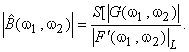
where  is obtained from an original undergraded image that is similar in content to is obtained from an original undergraded image that is similar in content to  . From (6.4.17) and (6.4.18) . From (6.4.17) and (6.4.18)
 |
(6.4.19) |
Despite various assumptions and heuristics used in derivation of (6.4.19), a reasonable estimate of  can be obtained from (6.4.19). It is possible to derive an expression for the phase can be obtained from (6.4.19). It is possible to derive an expression for the phase  in manner analogous to the derivation of in manner analogous to the derivation of  in (6.4.19). This approach has not yet been successful, however, partly because an image's details affect the phase function, and the phase of one image appears to contain little information about the phase of another image, even when the two images have similar contents. In the absence of the good method to estimate in (6.4.19). This approach has not yet been successful, however, partly because an image's details affect the phase function, and the phase of one image appears to contain little information about the phase of another image, even when the two images have similar contents. In the absence of the good method to estimate  is assumed to be zero. Once is assumed to be zero. Once  is estimated, inverse filtering or its variation, discussed in Section 6.4.1, can be used to reduce blurring. is estimated, inverse filtering or its variation, discussed in Section 6.4.1, can be used to reduce blurring.
Another blind deconvolotion method can be developed by assuming that the effective size (region of support) of  is much smaller than is much smaller than  . In this method, the degraded image . In this method, the degraded image  is segmented into subimages is segmented into subimages  by using nonoverlaping rectangular windows. The window size is chosen such that it is much larger than the effective size of by using nonoverlaping rectangular windows. The window size is chosen such that it is much larger than the effective size of  but smaller than size but smaller than size  . The subimage . The subimage  is then assumed to be is then assumed to be
 |
(6.4.20) |
where  is the original image segmented by the same window used to obtain is the original image segmented by the same window used to obtain  . . |