Reduction of blocking effect
(i) The blocking effect can be reduced in some cases by LP filtering the processed image in only the subimage boundary regions.
(ii) Another method of reducing blocking is to overlap the subimages.
In this method, to obtain a subimge, a window  is applied to degraded image is applied to degraded image  to be processed. The window to be processed. The window  is chosen to satisfy two conditions is chosen to satisfy two conditions
This condition implies that simple addition of the unprocessed subimages will result in the original image.
(b) Second condition requires that  to be a smooth function that falls close to zero near the window boundaries. This tends to reduce the possible discontinuous or degradation that may appear in the subimage boundaries in the processed image. to be a smooth function that falls close to zero near the window boundaries. This tends to reduce the possible discontinuous or degradation that may appear in the subimage boundaries in the processed image.
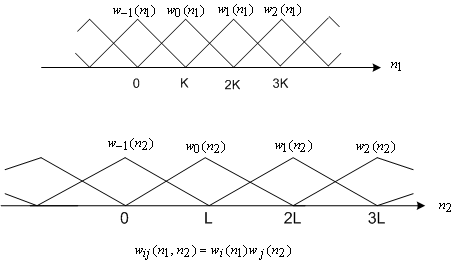
One of the many ways to find a smooth 2-D window that satisfies both these conditions is to form separable 2-D window from two 1-D window that satisfy conditions (i) & (ii) i.e.  . Two such window functions are the 2-D separable triangular and Hamming windows overlapped with their neighboring windows by half the window duration in each dimension. . Two such window functions are the 2-D separable triangular and Hamming windows overlapped with their neighboring windows by half the window duration in each dimension.
| Figure 9.7 Example of two dimensional separable triangular window |
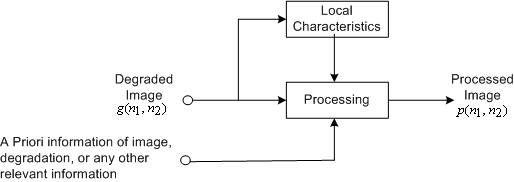
A general adaptive image process system is shown below. The processing to be done to each pixel or subimage is adapted to the local characteristics of the image, the degrading and any other relevant information.
Figure 6.8 General adaptive image processing system |
Determining what type of processing to use depends on a numbers of factors. These include the type of knowledge we have about the image and how this knowledge can be exploited in estimating the parameters of the process-
method.
Adaptive Weiner filter
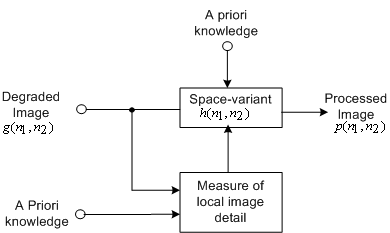
Most adaptive restoration algorithms for reducing additive noise in an image can be represented by the system in Figure 6.9. A priori knowledge to problem at hand e.g. What class of images to or nature of degrading character from knowledge of degrading sources From the degradation image and prior knowledge some measure of the local details of the noise free image is determined. One such measure is the local variance. A space variant filter  which is a function of the local image details and of additional prior knowledge is then determined. The space variant filter is then applied to the degraded image in the local region from which the space variant filter was designed. When the noise is wideband, the space-variant filter is low pass in character. In low detail image regions such as uniform intensity regions, where noise is more visible than in high detail regions a large amount of low pass filtering (low cut off frequency) is performed to reduce noise. which is a function of the local image details and of additional prior knowledge is then determined. The space variant filter is then applied to the degraded image in the local region from which the space variant filter was designed. When the noise is wideband, the space-variant filter is low pass in character. In low detail image regions such as uniform intensity regions, where noise is more visible than in high detail regions a large amount of low pass filtering (low cut off frequency) is performed to reduce noise.
Since there is little signal variation in low detail regions, large amount of low pass filtering does not affect the signal component. In high detail image regions such as edges, where a large signal component is present, only a small amount of low pass filtering is performed so as not distort the signal component. This does not reduce much noise, but the same noise is less visible in the high detail region than is low detail regions.
| Figure 9.9 Typical adaptive image restoration system for additive noise reduction |
Depending on which specific measure is used to represent local image details and how the filter  is determined as a function of local image details, there exists a number of algorithms. is determined as a function of local image details, there exists a number of algorithms.
One of the many possibilities is to adaptively design and implement the Wiener filter.
The Wiener filter requires the knowledge of signal mean  , noise mean , noise mean  and power spectrums and power spectrums
 and and
 Instead of assuming a fixed Instead of assuming a fixed  , ,  , ,
 , ,
 for the entire image, they can be estimated locally. This will result in space variant Weiner filter. Even within this approach many variations may be possible, depending on how for the entire image, they can be estimated locally. This will result in space variant Weiner filter. Even within this approach many variations may be possible, depending on how  , ,  , ,
 , ,
 are estimated locally and how the resultant filter are estimated locally and how the resultant filter  is implemented. is implemented.
|