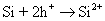
Often a conductivity/pH modifier is added to this system to vary the resistance of the electrolyte as well as the dissolution rate of oxide in it. It is also possible to carry out an anodisation process in a nonaqueous solution. However, the requirement of this electrolyte is that one of its dissociation products be the (OH) - ion. Reactions leading to anodic oxidation of silicon are as follows:
Water in the electrolyte medium dissociates into H + and (OH) - :

The difference in electrochemical potentials between silicon and the electrolyte results in charge transfer from silicon until equilibrium is established. This leaves the surface layer partially depleted of electrons. During anodisation, holes are supplied from the bulk of semiconductor to the semiconductor-electrolyte interface, thus promoting the silicon surface atoms to a higher oxidation state :