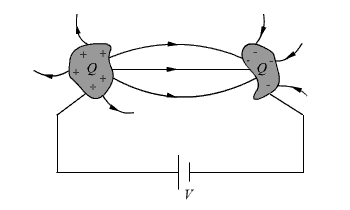
Fig 2.19: Capacitance and Capacitors
When a d-c voltage source is connected between the conductors, a charge transfer occurs which results into a positive charge on one conductor and negative charge on the other conductor. The conductors are equipotential surfaces and the field lines are perpendicular to the conductor surface. If V is the mean potential difference between the conductors, the capacitance is given by  . Capacitance of a capacitor depends on the geometry of the conductor and the permittivity of the medium between them and does not depend on the charge or potential difference between conductors. The capacitance can be computed by assuming Q(at the same time -Q on the other conductor), first determining
  using Gauss’s theorem and then determining
  . We illustrate this procedure by taking the example of a parallel plate capacitor.
. Capacitance of a capacitor depends on the geometry of the conductor and the permittivity of the medium between them and does not depend on the charge or potential difference between conductors. The capacitance can be computed by assuming Q(at the same time -Q on the other conductor), first determining using Gauss’s theorem and then determining . We illustrate this procedure by taking the example of a parallel plate capacitor.