10.2.1 Frequency-domain Interpretation of Matched Filter
We may also be view the matched filter in frequency domain, using Parseval’s theorem the replica-correlator can be expressed as
![N∑ -1 y [n ] = h[n - k]x[k] k=0](images/1.jpg)
where H(f) and X(f) are the discrete-time Fourier transforms of h[n] and x[n], respectively. From matched filter interpretation, H(f) =  {h[n]} = {s[N - 1 - n]}, where {.} represents the discrete-time Fourier transform. So the filter Fourier transform H(f) can be shown to be
![h[n] = s [N - 1 - n] n = 0, 1,...,N - 1](images/3.jpg)
then we have
![N∑ -1 y [n] = s[N - 1 - (n - k )]x[k] k=0](images/4.jpg)
On sampling the output of the filter at n = N - 1 we have
![N∑-1 y [N - 1] = s[k ]x[k] k=0](images/5.jpg)
10.2.2 Matched Filter as Maximizer of Signal-to-Noise Ratio
There is another property of matched filter that it maximizes the signal to noise ratio (SNR) at the output of the filter. To show this we consider all detectors of the form of FIR filter but with arbitrary impulse response h[n] over [0,N - 1] and zero otherwise. Now if we define the output SNR η as
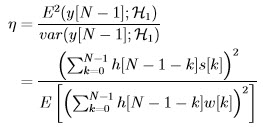
Let s = [s[0],s[1],…s[N - 1]]T , h = [h[0],h[1],…h[N - 1]]T and w = [w[0],w[1],…w[N - 1]]T , then using the vector notation we can write

On using the Cauchy-Schwartz inequality, we have
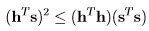
with equality if and only if h = ks, where k is any constant. Hence

The maximum output SNR ηmax is attained for (letting k = 1)

or equivalently

which turns out to be matched filter.
Remark: Note that for the detection of a known signal in WGN, the NP criterion and the maximum SNR criterion both lead to the matched filter detector. The maximum SNR is
ηmax = sTs∕σ² = ε∕σ² , where ε is the energy of the signal. One can easily guess that the performance of the matched filter detector would increase monotonically with ηmax.