- Since a Model is a representation for a specific purpose, there can
be two kinds of device models for Circuit analysis:
(i) Models to be used with circuit simulation
(ii) Models to be used for "hand analysis" of circuits
- In the first case, the models have to be as accurate as possible without
compromising
simulation speed.
They can be nonlinear and relatively complex because they are numerically evaluated.
- In the second case, a simple model that would allow a reasonably accurate
estimate of circuit characteristics with minimum computational effort
is required. These models are commonly linear and obtained through simplification
of more complex models using appropriate assumptions.
- The models of devices used for circuit simulation are general purpose
in nature so that they can be used in a wide variety of situations.
This results in their complexity.
- On the other hand, models for "hand analysis" of circuits
have limited range of validity. Due to the requirements of both simplicity
as well as reasonable accuracy, several simplifying assumptions have
to be used which restrict their range of application.
- There are a variety of models here, each catering to a specific kind
of analysis problem.
A model of a PN Junction diode suitable for circuit simulation can be obtained using the general expression for current derived in preceding lectures:
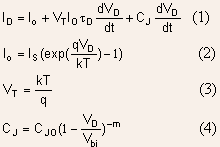
- The model can be made more accurate by including a parameter called
the ideality factor n, to model the departure of real diode behavior
from the ideal diode characteristics. A series resistance
 can also be included to model the diode behavior more accurately at
high current densities.
can also be included to model the diode behavior more accurately at
high current densities.

- As mentioned earlier, the model for junction capacitance is not very
accurate in forward bias especially as it begins to approach the built-in
Voltage. A better capacitance model uses the conventional expression
upto

For higher voltages, a different model such as the one given below may be used
For

The revised model now has eight parameters which are listed below, along with their SPICE representation and default values.
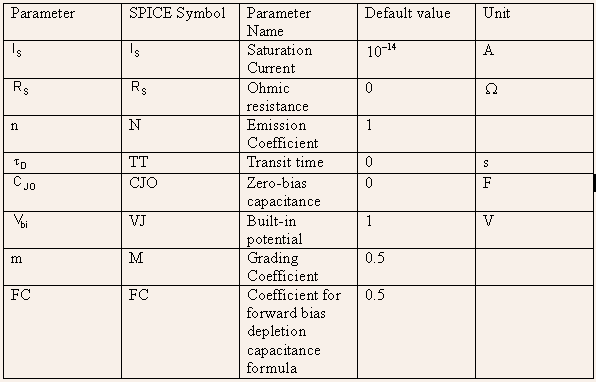
- The SPICE model for the diode includes several other parameters describing
the reverse characteristics and breakdown. There are parameters for
modeling noise also which has not been dealt with in the present treatment.
In all there are at least 15 parameters in the diode model.
- It is obvious that this model is not suitable for "mental"
simulation of circuits. As mentioned earlier, there are several models
that are used for different kinds of "hand analysis" problems:
Consider first the dc model:
Even an expression of the form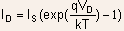 is unsuitable for analysis of a simple circuit shown below due to its
nonlinear nature:
is unsuitable for analysis of a simple circuit shown below due to its
nonlinear nature:
The analysis of the simple diode circuit requires solution of a nonlinear equation:
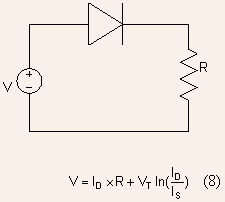
In such cases the analysis is greatly simplified through use of the following simple diode model:
In forward bias:

 is
frequently taken as between 0.6-0.7 V. The basis for this model is the
weak (logarithmic) dependence of the diode voltage on current so that
in comparison with other linear elements, the voltage across can be
assumed to be constant.
is
frequently taken as between 0.6-0.7 V. The basis for this model is the
weak (logarithmic) dependence of the diode voltage on current so that
in comparison with other linear elements, the voltage across can be
assumed to be constant.
- If the applied bias is such that
 is
much larger than say about 100mV (expected
is
much larger than say about 100mV (expected
deviation in diode voltage for currents which are two orders of magnitude different) then the simplified model gives fairly accurate results.
- The dc model can be used under transient conditions also provided
the frequency of the waveform is lower than the inverse of the transit
time.
- In reverse bias the diode can simply be modeled as an open circuit.
For situations where the excitation is of the form:

where.gif) is
the dc forward bias voltage and
is
the dc forward bias voltage and .gif) is
the small sinusoidal signal riding on it, a small signal model of the
diode is useful. It can be derived as follows:
is
the small sinusoidal signal riding on it, a small signal model of the
diode is useful. It can be derived as follows:
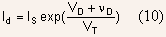
where is
the net current flowing though the diode has both a dc and an ac component
is
the net current flowing though the diode has both a dc and an ac component
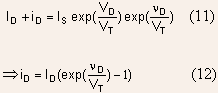
Eq.(12) can be re-written as
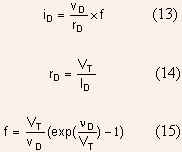
Eq. (13), which represents the relationship between small signal diode current and small signal diode voltage is known as the low frequency small signal model of the diode.
For so
that the model is simply a resistor
so
that the model is simply a resistor

This simplified linear model is used to a great advantage in wide variety of situations .
- It is to be noted that the small signal model was obtained basically
through linearization of the large signal non linear model. All that
needs to be done is a Taylor series expansion of the model equations
around a dc bias point.
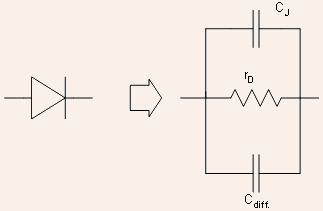
- The small signal model for the high frequency case can be quickly
obtained by noting that the contributions of the capacitive terms is
:
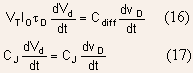
Therefore, the high frequency model is simply the low frequency model along with capacitances in parallel as shown below:
- The small signal model is valid only when the small signal diode voltage
is much less than the thermal voltage. The table below shows the accuracy
of this model for different values of small signal voltage


+0.1 5% -0.1 -4.8% +0.5 30% -0.5 -21.3% +1 72% -1 -37%
- If the small signal voltage is a sinusoidal voltage, then the small
signal model overestimates the peak value on the positive side and underestimates
on the negative side. As a result, if peak-to-peak signal value is evaluated,
the error even at
 is
less than 10%
is
less than 10%
- Another model that is very useful particularly for large signal transient
analysis is the charge control model. This model along with its application
has already been discussed earlier.
Example 5.1 Can a small signal model be used for the estimation of sinusoidal current flowing through the diode in the circuit shown below. Assume low frequency case.
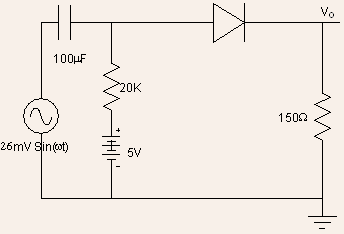
Solution : The dc analysis of the diode gives a forward current of (5-0.7)/20K = 0.21mA. Let us apply the small signal model and then apply a consistency check. The small signal resistance of the diode will be
 .
The small signal circuit is shown below:
.
The small signal circuit is shown below: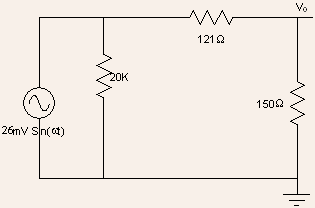
The small signal voltage drop across the 121
 resistor
(or the diode) will be 11.6mV. Now for the validity of small signal model,
this voltage drop should be much smaller than the thermal voltage. This
is roughly half the thermal voltage and accoding to the table given in the
text, the errors would be of the order of 30%.
resistor
(or the diode) will be 11.6mV. Now for the validity of small signal model,
this voltage drop should be much smaller than the thermal voltage. This
is roughly half the thermal voltage and accoding to the table given in the
text, the errors would be of the order of 30%.