Example 5.1 : Determine the specific contact resistance of a contact formed by simply depositing Aluminum on N-type Silicon of doping  .
Such a contact will be a Schottky contact which will obey the current
equation: .
Such a contact will be a Schottky contact which will obey the current
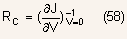
equation: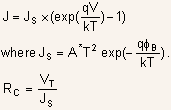 Differentiation
of the above equation gives: Differentiation
of the above equation gives:For a barrier height of 0.7 eV,  Example 5.2 : Such a large contact resistance is completely unacceptable. To understand what would constitute a good value for the contact resistance, let us consider the example of a PN junction diode with a contact area of  .
Calculate the contact resistance for contact resistivities of .
Calculate the contact resistance for contact resistivities of  (b) Calculate also the voltage drop across the contact for a current of 1mA. (c) Determine the factor by which the diode’s characteristics will get modified as a result of this voltage drop. Solution :  Because of the exponential nature of diode’s characteristics (~exp(qV/kT)), the modification factor will be  The table below shows the resistance due to contact, voltage drop across it and the modification of diode’s characteristics for various values of specific contact resistances.
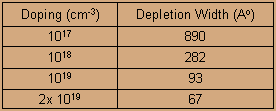
Example 5.3 : Determine depletion widths for Schottky barrier diodes made on N-type Silicon with doping values of  Assume that barrier height is 0.7eV .Using the expressions derived
earlier, we obtain
Assume that barrier height is 0.7eV .Using the expressions derived
earlier, we obtain
 ,
the barrier width is very narrow making tunneling very significant. ,
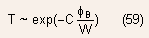
the barrier width is very narrow making tunneling very significant.Since the depletion width goes as  the
specific contact resistance, being inversely proportional to transmission
probability when tunneling becomes the dominant current conduction
mechanism can be expressed as: the
specific contact resistance, being inversely proportional to transmission
probability when tunneling becomes the dominant current conduction
mechanism can be expressed as: 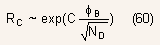 The expression above shows that a small barrier height and high doping level is required to obtain good contacts. For  ,
the specific contact resistance is determined entirely by the tunneling
process and decreases rapidly as doping is further increased. ,
the specific contact resistance is determined entirely by the tunneling
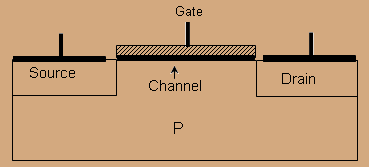
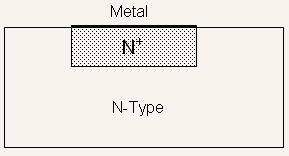
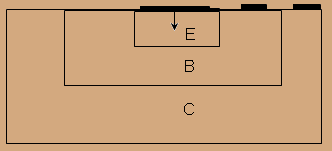
process and decreases rapidly as doping is further increased.As a result, a contact to an N or P-type semiconductor is made by first heavily doping the semiconductor region under the contact and then depositing a metal such as aluminum over it as illustrated in the Figure.
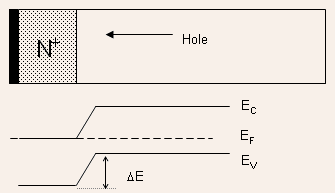
Although, a contact like this is a good Ohmic contact for electrons, it is however, a poor contact for holes! The reasons for this can be understood by considering a 1-D abstraction of the above schematic as shown below:
The holes travelling from the  see
a barrier of height see
a barrier of height  which
obstructs their flow to the contact. As a result, these contacts
are called reflecting contacts for the minority carriers. which
obstructs their flow to the contact. As a result, these contacts
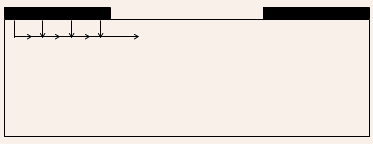
are called reflecting contacts for the minority carriers.The current flow under the contacts was assumed to be perpendicular for the cases discussed so far. There are contacts however, where the current flow is lateral as illustrated by the Figure below:
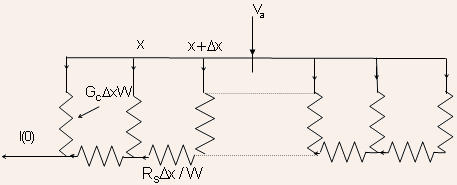
The contact resistance is now determined not only by the specific resistance of the contact but also by the sheet resistance of the semiconductor layer underneath. These contacts can be modeled using a transmission line model described below:
Definitions: -  is
the sheet resistance of the semiconductor underneath the contact
so that is
the sheet resistance of the semiconductor underneath the contact
so that  represents
the incremental series resistance, where W is the width of the contact
perpendicular to the plane of the diagram. represents
the incremental series resistance, where W is the width of the contact
perpendicular to the plane of the diagram.-  where,
Rc is the specific contact resistance so that where,
Rc is the specific contact resistance so that
 represents
the conductance of the vertical section represents
the conductance of the vertical section Contact resistance:  The following set of equations can be easily written for the transmission line representation 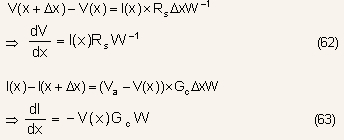 The equations above lead to the following differential equation: 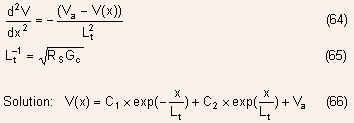 For simplicity we shall take a contact that is long enough in the x-direction and assume that  .
If this the case then .
If this the case then  Using
the other boundary condition that I at x=0 is I(0) , we obtain Using
the other boundary condition that I at x=0 is I(0) , we obtain  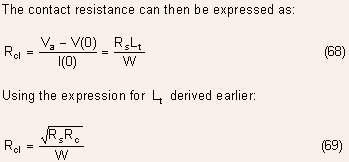 The contact resistance in this case scales with only the width of the contact and not its area as for the earlier case. It is therefore specified as  in
units of in
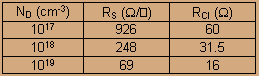
units of  Example 5.4 : Determine the lateral contact resistance for a contact of area  specific
contact resistance of specific
contact resistance of  and
a set of doping values given below. The semiconductor under the
contact is N-type of thickness 1micro metre. and
a set of doping values given below. The semiconductor under the
contact is N-type of thickness 1micro metre.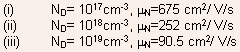 Solution : The sheet resistance of the semiconductor is given by the expression:  ,where
t is the thickness of the semiconductor. This equation along with
Eq. (69) gives the following values for contact resistance: ,where
t is the thickness of the semiconductor. This equation along with
Eq. (69) gives the following values for contact resistance:
The example illustrates that very low values of sheet resistance are required to obtain a small lateral contact resistance and even then it is much higher that the contact resistance  for the above example) when the current flow under the contact is
vertical.
for the above example) when the current flow under the contact is
vertical.
Example 5.5 : For an emitter area of  ,
specific contact resistivity of ,
specific contact resistivity of  determine the maximum value of emitter current before the contact
begins to make appreciable difference to the transistor’s characteristics.
determine the maximum value of emitter current before the contact
begins to make appreciable difference to the transistor’s characteristics.
Solution : Taking a maximum contact voltage drop of  so
that there is less than 10% change in transistor’s current,
we obtain so
that there is less than 10% change in transistor’s current,
we obtain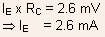 Suppose now the emitter area is scaled by a factor of 10, while keeping the emitter current constant so as to improve the transistor’s performance (which upto a limit improves as the collector current density increases). The voltage drop across the contact now becomes 50mV, which is very significant! If the voltage drop is to be maintained at the earlier 5mV level, the specific contact resistance will have to be lowered to  Consider now a MOSFET and the impact of the source contact resistance:
The current under the source flows laterally so that the expression  is
the contact resistance here. The role of the source resistance is
that it lowers the transconductance of the device is
the contact resistance here. The role of the source resistance is
that it lowers the transconductance of the device where  is
the transconductance of the transistor in the absence of a source
resistor. We would like is
the transconductance of the transistor in the absence of a source
resistor. We would like to
be as small as possible. A simplified expression for the transconductance
is to
be as small as possible. A simplified expression for the transconductance
is  As the channel length and width are scaled by a factor K, the oxide thickness is also reduced so that for a fixed supply voltage, the transconductance increases in magnitude.The resistance due to the contact however, increases by a factor K as the width is scaled. Therefore, the product would
become larger with scaling making it necessary to reduce the contact
resistance with scaling.For the case, where the supply voltage is scaled also, the transconductance may not increase but due to increase in contact resistance, the problem persists though with lesser impact. Example 5.6 : Determine the factor by which the transconductance of a MOSFET is reduced as a result of voltage drop across the source resistance . The MOSFET has the following characteristics:  The source contact has the following characteristics:  (b) Redo your calculations for  but
W/L = 10 as before. Assume that new , but
W/L = 10 as before. Assume that new ,  For
the contact assume that every thing is same except that For
the contact assume that every thing is same except that  . .Solution : Using Eq.(70) and (71), we obtain  =
0.95 =
0.95(b) As a result of scaling of channel length by a factor of 2, the intrinsic transconductance will increase by a factor of 2 and the source resistance will also increase by the same factor. As a result the product
becomes four times and =
0.84 now.
|

 is
required.
is
required. ,
a nine orders of magnitude reduction!
,
a nine orders of magnitude reduction! is
negligible but as the doping is increased, it becomes increasingly
important.
is
negligible but as the doping is increased, it becomes increasingly
important.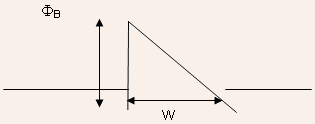
 ,
the voltage drop
,
the voltage drop  should
be much smaller than the thermal voltage V
should
be much smaller than the thermal voltage V