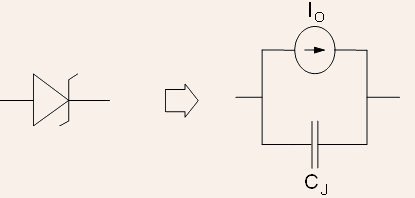
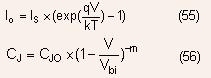
The equation for current under dynamic conditions can be expressed
in the form an equivalent circuit as shown below:
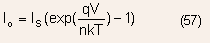
The model can be made more accurate by including a parameter n to model
the nonidealities in the current caused by modification of barrier height
due to image force lowering, tunneling etc
The effects of voltage drop across the ohmic contact and the neutral
N-region can be taken into account through a series resistance  as
illustrated as in the Figure:
as
illustrated as in the Figure:
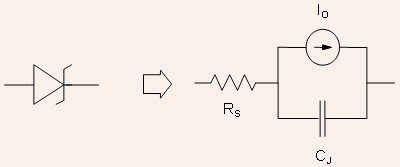
- This simple circuit model is characterized by five parameters:
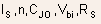
- This model is more useful for use with circuit simulators than for
“hand analysis” of circuits. A variety of simplified models
appropriate for different situations are used for the latter. These
are discussed in detail in the context of PN junctions.
- Among the models is the small signal representation of the device
representing the response of the diode to incremental changes in applied
voltage around a particular bias point:
- The small signal model can be obtained through linearization of
the general large signal model described earlier. This procedure is
again described in detail with respect to PN junctions and only the
result is shown below:
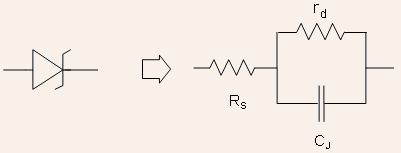
 ;
small signal resistance of the diode. The usefulness of the small
signal model stems from its linear nature.
;
small signal resistance of the diode. The usefulness of the small
signal model stems from its linear nature.
 are
the dc voltage and current across the diode.
are
the dc voltage and current across the diode.  is
a small signal superimposed on the dc diode voltage and
is
a small signal superimposed on the dc diode voltage and  is
the small signal response of the diode. The relationship between
and is
known as the small signal model.
is
the small signal response of the diode. The relationship between
and is
known as the small signal model.Example 4.1 :Determine the small signal resistance and capacitance of a Schottky diode formed on an N-type Silicon of doping
 at
a current density of
at
a current density of 
Assume that
 Repeat
your calculations for a current density of
Repeat
your calculations for a current density of 
Solution : Using expressions derived earlier in the text, the built in voltage of the diode is calculated to be 0.6 Volts and the forward On voltage to be 0.33 Volts. Assuming an ideality factor of 1, the small signal resistance is calculated to be
 The
junction capacitance is calculated to be 17.5 pF.
The
junction capacitance is calculated to be 17.5 pF.The RC response time of the diode will be

If the current density is increased by three orders of magnitude, then the small signal resistance will decrease by
 but
the capacitance as seen earlier will remain relatively unchanged. As a
result, the response time of the diode will decrease to a few picoseconds.
but
the capacitance as seen earlier will remain relatively unchanged. As a
result, the response time of the diode will decrease to a few picoseconds.- This shows that the response time of the Schottky diodes is very small and they can work upto frequencies exceeding 1Ghz !
- To summarize, Schottky diodes have the advantages of small turn on voltage, fast response time but suffer from high leakage current and low breakdown voltage.