- Almost all the metals form a junction with Silicon such that a barrier exists for the flow of electrons in N-type material and for holes in P-type material. We shall confine out attention to Schottky barriers on N-type semiconductors only
- Although the barrier exists for flow of electrons in both the directions (metal-to-semiconductor or semiconductor-to-metal), the nature of the barrier is different.
- While the barrier to flow of electrons from metal-to-semiconductor remains fixed, the barrier to flow of electrons from semiconductor-to-metal changes as a bias is applied across the junction.
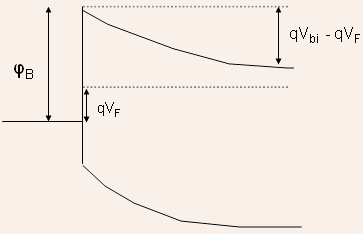
It can be seen from the Figure that the semiconductor-to-metal barrier is reduced by qVF.
In Forward bias, when metal is made positive with respect to the semiconductor, there should be a net flow of electrons towards the metal.The current in general can be expressed as:

Since the barrier to flow of electrons from the metal-to-semiconductor remains unchanged, so the component
 remains
practically the same as at equilibrium.Due to reduction of barrier height
for flow of electrons from the semiconductor-to-metal, the current
remains
practically the same as at equilibrium.Due to reduction of barrier height
for flow of electrons from the semiconductor-to-metal, the current  increases
substantially causing significant current to flow. When metal is made
negative w.r.t N-type semiconductor, the barrier height is increased by
qVR as shown in the Figure.
increases
substantially causing significant current to flow. When metal is made
negative w.r.t N-type semiconductor, the barrier height is increased by
qVR as shown in the Figure. 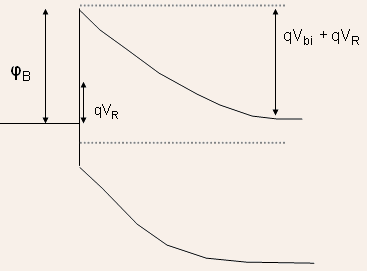
In this case, the barrier to electron flow into the metal has been increased making
negligible.Since the barrier to flow of electrons from the metal into the semiconductor remains the same,
remains
the same at a very low value due to large barrier height. Therefore,the
current is small and relatively independent of voltage. Current Path from Ohmic Contact To Schottky Contact
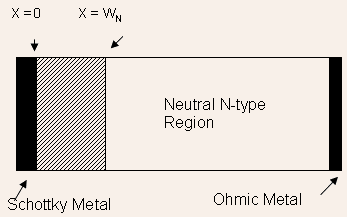
The flow of electrons from the backside Ohmic contact to the Schottky metal can be broken into three distinct parts:
- flow of electrons across the Ohmic contact and the neutral N-region
- flow of electrons across the depletion region
- flow of electrons across the Schottky metal-semiconductor interface
 Electron Flow across Ohmic contact and neutral N-region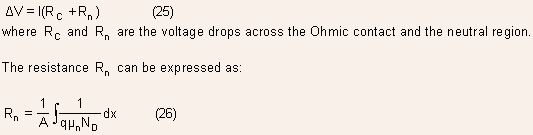
We normally want to keep the IR voltage drop as small as possible so that when Schottky diode is ON, the forward voltage drop is as small as possible.
Current Flow across the Depletion RegionThe current flow involves both drift and diffusion currents.
The two currents oppose each other with electrons tending to move towards the metal via diffusion and away from the metal via drift. In equilibrium, they cancel each other.
As a result of forward bias, the electric field gets reduced making the diffusion current exceed the drift current and causing a net flow of electrons towards the metal.

Using the relation
 and
integrating after multiplying both sides by
and
integrating after multiplying both sides by 
 Boundary Conditions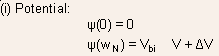
where V is the applied voltage and DV is the drop across the ohmic contact and neutral N-region.
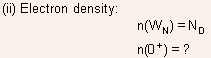
It is not clear as of now what the electron density at the interface should be.
The variation of voltage
 across
the depletion region can be determined by invoking the depletion approximation
as done under equilibrium:
across
the depletion region can be determined by invoking the depletion approximation
as done under equilibrium: 
The depletion width
 is
determined by the boundary condition for potential described earlier so
that
is
determined by the boundary condition for potential described earlier so
that
With the boundary conditions listed earlier and the expression for variation of potential across the depletion region, the current can be expressed as :
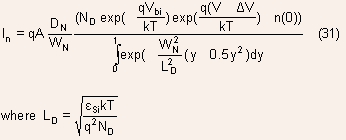
For typical values of doping and voltages

This allows the denominator of Eq. (31) to be simplified as
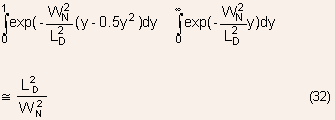
Eq.(31) can now be written as
 Thermionic Emission:
- The expression for current can be obtained if the value of n(0) is known. For this we shall have to look at the transport across the metal-semiconductor interface.
- To begin with, we shall assume that the transport mechanism is predominantly thermionic emission and not tunneling
- Thermionic emission is one of the dominant mechanisms of current
flow across abrupt barriers as illustrated below:
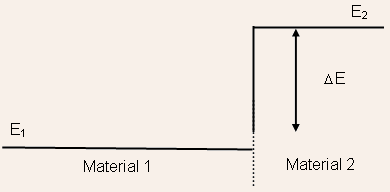
- There may be large number of electrons in material-1 but only a few can contribute to current flow and this number will increase as temperature is raised
- The electrons, which can contribute to current flow, must have the following characteristics:

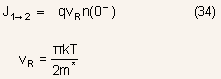
- If the electrons are assumed to be moving randomly, then the current
due to flow of electrons from material-1 to material-2 can be written
as:
- VR is the average velocity of electrons in the positive x direction. Similarly, the flux of electrons towards materla-1 can be written as:
- The net electron current can therefore be expressed as

 is
the density of all the electrons at the interface that have an energy
greater than or equal to the barrier height.
is
the density of all the electrons at the interface that have an energy
greater than or equal to the barrier height.
 is
the electron density at the interface on the right side.
is
the electron density at the interface on the right side. With this expression we can now determine the I-V characteristics of the Schottky barrier diode.
| There can be two extreme cases: | |
| (i) current is determined primarily by
drift-diffusion flow of electrons across the depletion region (ii) current is determined primarily by thermionic emission. |
|
- The first case implies that the bottleneck to current flow is drift
diffusion across the depletion region. If this is true then the current
should be much smaller than either the left or the right flux of electrons
in the expression for thermionic current.

Since the metal can be assumed to remain at equilibrium despite the current flow:


Since the current densities are most of the time several orders of magnitude larger than this, the first extreme case will not hold true at all.
- Let us take the other extreme case. In this case, if drift-diffusion
is not a bottleneck, then the net current should be much less than
either of the two terms in the expression given by Eq.(33)

Substitution of typical values shows that this condition is indeed satisfied, so that it can be assumed that the current is determined primarily by thermionic emission.
The above inequality along with Eq. (33) also allows us to write:
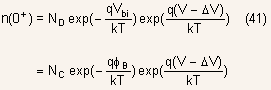
The net current density through the diode can be written as
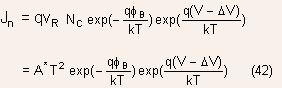
where A* is known as the Richardson constant and has a value of for
N-type Silicon.
for
N-type Silicon.
- A similar expression holds for current flow in P-type Schottky
barriers for which the Richardson constant is
 for
Silicon.
for
Silicon.
Example 2.1 : For an N-type Schottky diode with barrier height of 0.7eV, determine the forward on voltage for a forward current density of
 .
Compare your answer with a typical value of 0.6 Volts for a Silicon PN
junction at a comparable current density.
.
Compare your answer with a typical value of 0.6 Volts for a Silicon PN
junction at a comparable current density.Solution : Using Eq. (42) and assuming negligible voltage drop across neutral P-region we obtain VON = 0. 195 Volts, which is about 300mV lower that PN junction diode,has a reverse saturation current of
 according
to the expression just derived.The forward voltage drop for a current
density of
according
to the expression just derived.The forward voltage drop for a current
density of  turns
out to be ~0.45V.
turns
out to be ~0.45V.Example 2.2 : Repeat Q.2.1 for a P-type Schottky barrier diode with barrier height of 0.58eV.
Solution : Using Eq. (42) and assuming negligible voltage drop across neutral P-region at the low current density value, we obtain VON = 0. 195 Volts, which is about 400mV lower that PN junction diode. All nice things however, come at a price!
Example 2.3 : Calculate the reverse saturation currents for N and P Schottky diodes discussed above and compare it with a typical value of
 for
a PN junction diode.
for
a PN junction diode.Using the expressions derived earlier, the reverse leakage current turns out to be
 for
N Schottky and
for
N Schottky and  for
P Schottky diode.
for
P Schottky diode. Thus although Schottky barrier diodes can have a turn on voltage which is lower by 300-400mV, they also have a leakage current which is 3-4 orders of magnitude higher.
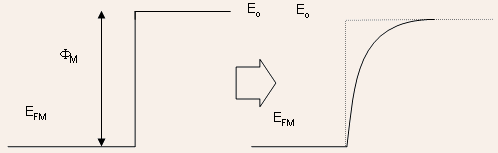
The I-V characteristics of the Schottky barrier is very sensitive to the barrier height. The barrier height depends on the applied bias due to a phenomenon known as image-force-induced barrier lowering.
In the representation of the energy band diagram of the metal so far, an abrupt barrier of height
 was
shown to exist between the electrons within the metal at Fermi energy
and the vacuum level outside. However, in actual practice, the potential
varies gradually.
was
shown to exist between the electrons within the metal at Fermi energy
and the vacuum level outside. However, in actual practice, the potential
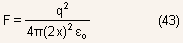
varies gradually.When the electron comes out of the metal, it faces an attractive force due to the positive image charge induced in the metal:
As a result of this force the potential energy varies as
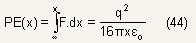
The variation of potential energy with distance is illustrated by the Figure below:
In the presence of a constant electric field, the net potential energy can be written as:
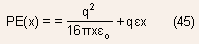
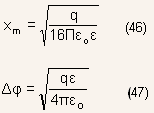
The potential energy has a maxima resulting in lowering of barrier height by an amount
 as
illustrated in the Figure
as
illustrated in the Figure 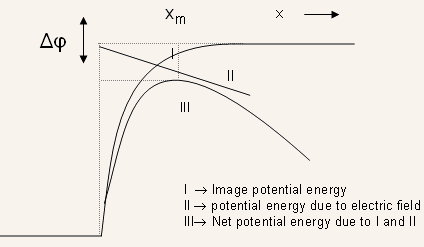 |
The analysis carried out for Metal-vacuum system can be extended to metal-semiconductor system as well with the difference that permittivity for Silicon should be used instead of that of vacuum.
Example 2.4 : Determine the barrier height of a Schottky diode at equilibrium using image force barrier lowering into account. Assume that

Solution : Taking
 ,
we obtain Vbi = 0.554Volts and
,
we obtain Vbi = 0.554Volts and 
Use of Eq. (47) gives
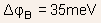 .Because
of the exponential dependence of current on barrier height, this amount
of reduction can have a significant impact on the I-V characteristics
. For example, if barrier lowering is neglected, then the reverse leakage
current will be under estimated by a factor
.Because
of the exponential dependence of current on barrier height, this amount
of reduction can have a significant impact on the I-V characteristics
. For example, if barrier lowering is neglected, then the reverse leakage
current will be under estimated by a factor  which
is ~4 for the present case but will increase as the reverse bias increases.
which
is ~4 for the present case but will increase as the reverse bias increases.As a result of barrier height lowering, the reverse current is not independent of voltage but increases significantly with increase in reverse bias.
As electric field increases further, avalanche multiplication begins to occur causing rapid increase in reverse current and eventually breakdown occurs. This is explained in more detail later on in the context of PN Junctions.
Example 2.5 : Sketch the energy band diagram for the metal semiconductor system shown below using simple work function theory and comment on whether the junction will have rectifying characteristics or not.

In this case the electrons will transfer from the metal into the N-type semiconductor and result in an accumulation of electrons at the surface. The final band diagram is shown below:
The barrier height
 =
-0.1 eV is negative ! There is no barrier to flow of electrons either
from the metal to the semiconductor or the other way around so that the
contact will have ohmic properties.
=
-0.1 eV is negative ! There is no barrier to flow of electrons either
from the metal to the semiconductor or the other way around so that the
contact will have ohmic properties.