While a function is usually defined at every value of the independent variable, the priomary importance of the unit impulse is not what it is at each value of t, but rather what it does under convolution. So from the point of view of the linear system analysis we alternatively define the unit impulse as a signal for which
x(t) = x(t) *  ,
for any x(t)
,
for any x(t)
All the properties of the unit impulse that we need can be obtained from the operational definition of the unit impulse.
Note:
The above definition of unit impulse follows from the fact that the impuse response of identity system is unit impulse itself and the output of any input x(t) is the convolution of x(t) and unit impulse. But the output of identity system is the input x(t) itself and hence
x(t) = x(t) *
 |
|
|
Singularity functions are functions which can be defines operationally in terms of their behavior under convolution. Consider the derivative system. The impulse response of this system is the derivative of unit impulse and it is called unit doublet. It is denoted by u1(t). Its working definition is
dx(t)/dt=x(t)*u1(t), for any signal x(t).
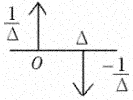 |
|
u1(t)
|
Similarly we define u2(t), the second derivative of unit impulse response as
d2x(t)/dt2=x(t)*u2(t)
 |
It is easy to see that u2(t)=u1(t) * u1(t).
In general uk(t), k N
is defined as
N
is defined as
uk(t)=u1(t)*.........*u1(t), k times
Using the above notation we denote
by u0(t).
We denote the running integral of
by u-1(t), which is the unit step function. Similarly:
u-2(t)=running integral of u-1(t)=t . u(t)
in general
u-n(t) = tn-1/(n-1)! . u(t)
all u-n are well defined for nN