|
2.2 Other Rigid Rod Polymers such as PBZT, PBO, PBI (2 Lectures) |
Fibres based on Aromatic Heterocyclic Polymers
|
|
The fundamental science of structure-property relationship developed in aramids has been further extended to form heterocyclic rigid rod polymers. In these polymers, the structures are even more rigid than those of p-aramids and pose greater difficulty in processing. |
|
Heterocyclic rigid-rod polymers can be classified into three categories |
- Polybenzazole
- Polybenzimidazole
- Polypyridobisimidazole
|
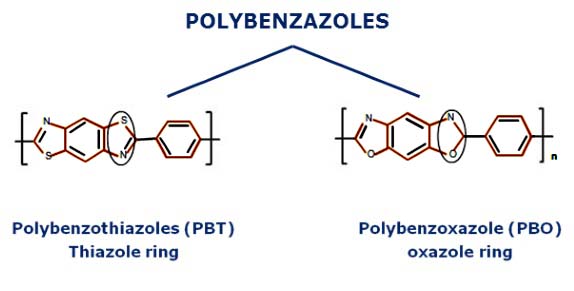
As shown below in Figure 1, polybenzazole polymers abbreviated as (PBX) include polybenzothiazoles (PBT) and polybenzoxazoles (PBO). The term also includes some semi rigid polymers such as poly (2,5(6)-benzoxazole)(ABPBO). The key structural feature of these two polymers is the formation of the benzothiazole and benzoxazole ring structures. |
|
|
Figure 1. Structures of PBT & PBO |
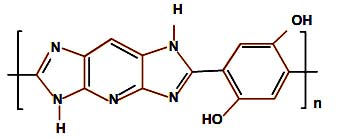
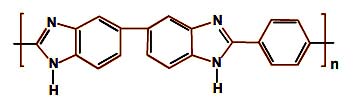
Polybenzimidazole (PBI) fibre was commercialized for its thermal stability in 1983 by Celanese. More recently, the poly(2,6-diimidazo(4,5-b:4,5-e) pyridinylene-1,4(2,5-dihydroxy-) phenylene) (PIPD), a member of polypyridobisimidazole class, was synthesized shown in Figure 2. |
|
|
Figure 2. Poly(2,6- pyridinylene-1,4 (2,5-dihydroxy) phenylene) (PIPD) or M5
|
|
Manufacture of Polybenzazoles
|
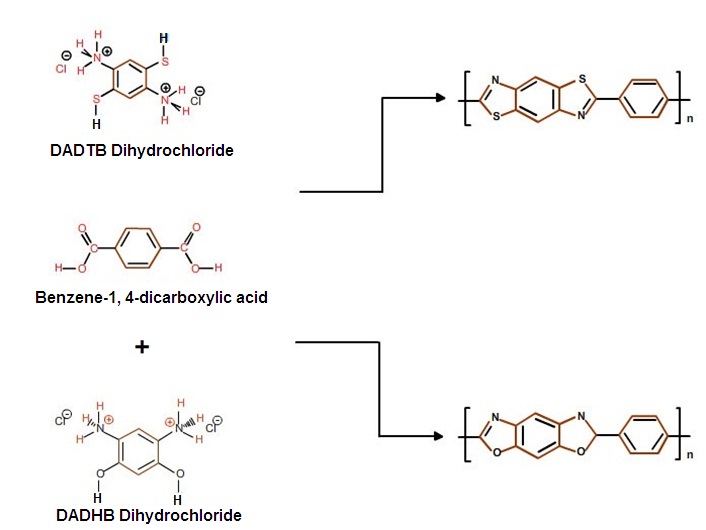
PBO or cis-PBO is synthesized by condensation polymerization of 4,6-diamino-1,3-benzenedoldihydrochloride(DABCO) with terephthalic acid (TA) at 60-80 °C, while trans-PBT is based on 2,5-diamino-1,4-benzene-dithioldihydrochloride (DABDT) and TA. Due to the high cost of manufacturing of PBT, PBO fibres have become more popular. The polymerization is carried out in poly (phosphoric) acid (PPA) solvent and molecular weights of about 50000-100000 g/mol corresponding to about 200-400 repeat units per chain are obtained. In synthesis of PBO, PPA plays a role as a solvent as well as catalyst and dehydrating agent. The spinnable solutions are obtained directly from the polymerization mixtures. |
|
|
These polymers decompose at high temperatures without melting and are soluble in very few solvent systems due to their rigid molecular backbone. PBO is soluble in strong protonic acids such as PPA, methane sulfonic acid (MSA), chlorosulfonic acid, and trifluoroacetic acid via backbone protonation, which weakens intermolecular interaction and facilitates dissolution. Several research groups have studied the solution properties of cis-PBO and have confirmed the high chain rigidity from the exponent value of 1.8 in the Mark–Houwink equation in MSA at 30 °C.
|
It has been reported to exist in anisotropic liquid crystal PBO phase in 100% sulphuric acid at 70 °C at about 5.5 wt% PBO. Polymerized lyotropic liquid crystalline PBO/PPA solutions are directly spun without polymer precipitation and redissolution via dry jet-wet spinning technique. PBO fibres are prepared using 13-17% solid content in poly-phosphoric acid solution at 60-90 °C. The structure formed during coagulation shows a network of oriented microfibrils. Heat treatment at 450-500 °C for one minute under tension results in about eight times and 10-20% improvement in modulus and strength, respectively. Similarly after high temperature treatment, the modulus of PBT fibres exhibits a remarkable improvement of 0.8-16 times while the fibre strength increases approximately by 50%. Improvement in overall axial orientation, crystal perfection and lateral order lead to improved mechanical properties. PBO fibres have been commercialized by Toyoba Co. Ltd., Japan under the trade name Zylon.
|
The tensile strength and modulus of PBO fibres are reported to be as high as 5.8 and 352 GPa (experimental fibre), respectively. The mechanical properties of PBO fibre depend on polymer molecular weight, as well as on processing and post processing conditions.
|
Tensile strength and modulus retention rates of PBO fibres have also been investigated under various environmental conditions such as temperature, humidity, and exposure to ultraviolet and visible light. At 400 °C, PBO fibre (Zylon HM) retains 75% of the room temperature modulus. However, high temperature with humidity has a drastic effect on strength. At 250 °C with saturated steam, the strength retention in PBO is below 20% of its room temperature value. Therefore, PBO fibres should be stored in low RH environment. PBO tensile strength also drops sharply with UV exposure in the initial stage, which indicates that the products of PBO fibre for outdoor use have to be protected from the UV radiation. Exposure to visible light also affects PBO strength. For example, one month exposure to two 35 W fluorescent lamps placed 150 cm away from the sample is reported to reduce the PBO fibre tensile strength to nearly 70% of its original value. The excellent chemical resistance to various organic solvents, acids, and bases leads to high strength retention; however, the PBO staple fibre showed low resistance under acid and base at high temperature. Besides tensile properties, fibre dimensional stability is also important for structural materials. The thermal shrinkage of PBO fibre after hot air treatment for 30 min without applying load was only about 0.2%, while under the same conditions, p-aramid and co-polyaramid exhibited about 0.5 and 0.7% shrinkage, respectively. Based on the creep testing, at 60% of the failure stress, failure time of 19 years is predicted for the Zylon HM fibre. Abrasion resistance of PBO on metal is higher than that of aramid fibres under the same load, while both the PBO and aramid exhibit much lower abrasion resistance than that of nylon or ultra high molecular weight extended polyethylene.
|
PBO fibres have specific values of strength and stiffness in excess of all other materials. These fibres also have excellent thermal properties and find application in heat-resistant felt in glass industry. Owing to these excellent properties, PBO fibres have vast range of applications. However, these fibres have poor performance under compression.
|
| PIPD or M5 Fibre |
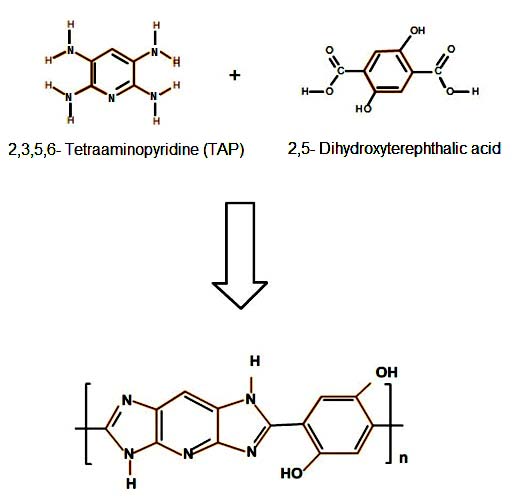
In order to develop rigid rod polymers with good compressive properties, rigid rod like polymers with the possibility of forming strong intermolecular hydrogen bonds are desirable. Polymerization of 2,3,5,6-tetra aminopyridine with 2,5-dihydroxyterephthalic acid (DHTA) can result in a polymer with hydroxyl groups at appropriate position to contribute to the hydrogen bond network envisioned for improved lateral strength |
|
|
| One can readily observe that that the structure of PIPD or M5 is similar to PBO and PBT except for the following differences |
- The central aromatic ring in M5 is pyridinyl rather than benzyl
- Presence of hydroxyl groups at 2-and 5-positions of diacid and
- The X group in benzazole ring structure is NH.
|
|
Polymerization is achieved by the synthesis of the TAP:DHTA 1:1 complex, or TD complex. This complex is significantly more stable against oxidation than TAP phosphate and it precipitates in a high yield from the combination of (alkaline) aqueous solutions of TAP and DHTA, Na or K salt upon neutralization. Polymerization by this route is fast (takes about 4– 8 h) and yields high MW polymer with high consistency in relative viscosities. The polymerization consists of heating the slurry of TD complex in polyphosphoric acid and P2O5 with a trace of tin powder in a reactor at 130 –140 °C, under inert conditions. The P2O5 content of the solvent system impacts the final molecular weight, and obviously only the highest purity TD complex results in formation of highest MW polymers. At 180 °C, the 18 wt% polymer is a nematic and has long relaxation times. Upon cooling it crystallizes at about 110 °C; the crystallized solution melts at about 140 °C. The as polymerized solutions with molecular weight (Mw) 60000-150000 were spun using conventional air-jet wet-spinning at 180 °C into a water or dilute phosphoric acid bath.
|
|
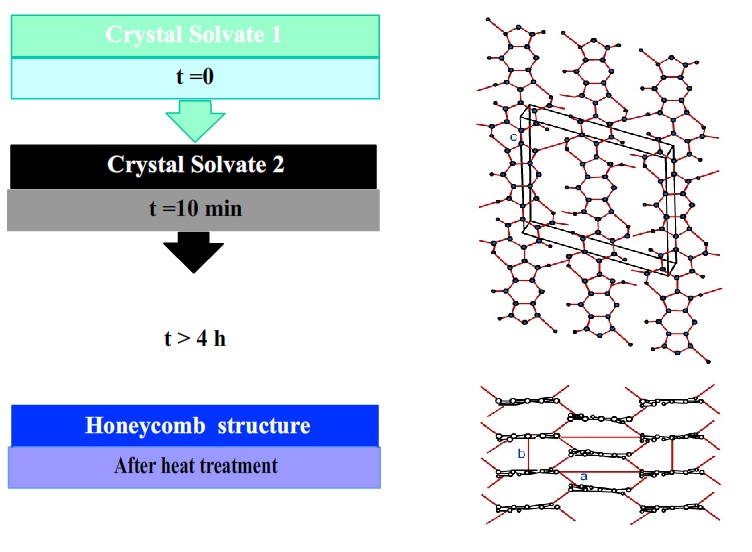
The XRD patterns of solidified polymer solution in PPA showed the existence of two different crystal solvate phases. The crystal solvate phase 1 in the polymer solution at room temperature changed to crystal solvate phase 2 which starts at 85 °C and is completed at 115 °C. It disappears above 135 °C and a nematic phase appeared. The transition from nematic phase to the crystal solvate can happen by cooling. The crystallinity of crystal solvates of PPID is higher than PBO and PBT. The coagulated and washed fibre is isolated as a crystal hydrate (as spun fibre). This transforms into a bidirectional hydrogen bonded structure during heat treatment process transforms this into the final high modulus “M5” crystal structure. The as-spun fibre shows attractive mechanical properties, comparable to para-aramid fibres, although the modulus is higher (about 180 GPa). The as spun fibre excels in flame resistance. The crystal-to-crystal transformation during the hot drawing leads to a much higher modulus, due to a more slender effective chain and stronger interchain bonding, coupled with an improvement of the orientation.
|
The rod like polymer molecules feature internal hydrogen bonds between -O-H groups and imidazole N atoms, and a network in both directions perpendicular to the rod like chains between imidazole N-H atoms and the O-H groups. This leads to a high shear modulus and shear strength and thus to good compressive properties of the M5 fibre. The honeycomb-like structure may explain the impact and damage tolerance properties of M5 products |
|
|
| The key features of M5 are that it has a higher compressive strength than PBO or PBT, and it is more stable to UV and hydrolytic action than PBO. It is reasonable to assume that the NH group contributes to the greater solubility and water absorbing capability of this polymer relative to PBO or PBT. |
Table 1. Provisional characterization of M5 fibre spun on the bench-scale |
Property |
Twaron HM |
CHS
(resin impregnated strands)
|
PBO
( toyoba data) |
M5 experiment
(Unidirectional composite test bars)
|
Tenacity (GPa) |
3.2 |
3.5 |
5.5 |
4 |
Elongation (%) |
2.9 |
1.5 |
2.5 |
1.2 |
E Modulus (GPa) |
115 |
230 |
280 |
330 |
Compr. Str. (GPa) |
0.58 |
2.1 |
0.4 |
1.6 |
Compr. Strain (%) |
0.5 |
0.9 |
0.15 |
0.5 |
Density(g/cm3) |
1.45 |
1.8 |
1.56 |
1.7 |
Water regain (%) |
3.5 |
0 |
0.6 |
2 |
LOI (%O2) |
29 |
- |
68 |
>50 |
Onset of thermal degradation, air (°C) |
450 |
800 |
550 |
530 |
Electr. Conduction (S/m) |
- |
++ |
- |
- |
Impact resistance |
++ |
-- |
++ |
++ |
Damage tolerance |
+ |
-- |
-e |
++ |
Weaving props. |
+ |
- |
+ |
+ |
Knot strength (%) |
+ |
-- |
0 |
0 |
|
| |