| Introduction to Jacquard
|
Jacquard shedding system was developed by Joseph Marie Jacquard (1752–1834) who was a French weaver and merchant . In case of cam and dobby shedding systems, large number of yarns passing through a heald is controlled as a group. Thus it precludes the possibility of controlling individual ends independently. Therefore, complicated woven designs cannot be made using cam or dobby shedding systems. With jacquard shedding system, individual ends can be controlled independently and thus large woven figures can be produced in fabrics. |
| Mechanical jacquard systems can be classified under three categories: |
- Single lift and single cylinder (SLSC)
- Double lift and single cylinder (DLSC)
- Double lift and double cylinder (DLDC)
|
| Single-Lift Single-Cylinder (SLSC) Jacquard |
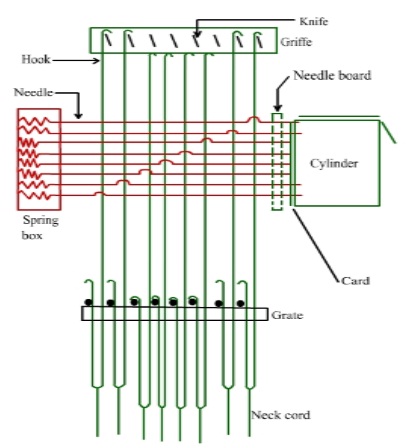
Figure 6.41 shows the simplified side view of SLSC jacquard. If the machine has the capacity to handle 300 ends independently, then it requires 300 hooks (one per end) which are vertically arranged and 300 needles (one per hook) which are horizontally arranged. For example, the needles can be arranged in six rows and each row will have 50 needles. In the side view, only six needles (one per horizontal row) are visible. Hooks, which are connected to individual ends through nylon cord (harness), are also arranged in six rows and each row is having 50 hooks. One knife is responsible for controlling the movement (lifting and lowering) of one row of hooks. However, whether a hook will be lifted or not will be ascertained by the selection mechanism which is basically a punched card system mounted on a revolving cylinder having square or hexagonal cross-section. The needles are connected with springs at the opposite size of cylinder. Therefore, the needles always exert some pressure in the right hand side direction (Figure 6.41). So, if there is a hole in the punch card corresponding to the position of a needle, then the needle will be able to pass through the hole and thus the needle will remain in upright position thus making it accessible to the knife when the latter has started its upward movement after descending to the lowest height. On the other hand, if there is no hole, then the needle will be pressed towards the left side against the spring pressure. Thus the kink (which partially circumscribes the stem of a hook) present in the needle presses the hook towards the left side making the latter tilted enough from the vertical plane so that the knife misses it while moving upward. Therefore, presence of a hole implies selection (ends up) and vice versa. A hole in this case is tantamount with a peg used on the lag of dobby shedding system. |
| In case of SLSC jacquard, if the loom speed is 300 picks per minute, the cylinder will turn 300 times per minute (5 times per second) and the knives should also reciprocate (up and down) 300 times per minute. Thus it hinders the high loom speed. When a particular hook (and the corresponding end) has to be in up position in two consecutive picks, in between the two peaks, in descends to its lowest possible height (determined by the grate) and then moves up again. Thus it produces bottom closed shed. This happens as one end is controlled by a single hook.
|
|
Figure 6.41: Side view of single-lift single-cylinder jacquard
|
| Features of SLSC Jacquard |
- 500 end machine will have 500 needles and 500 hooks
- Cylinder should turn in every pick
- Knives must complete the cycle of rise and fall in every pick
- Bottom closed shed is produced
|
| Double-Lift Single-Cylinder (DLSC) Jacquard |
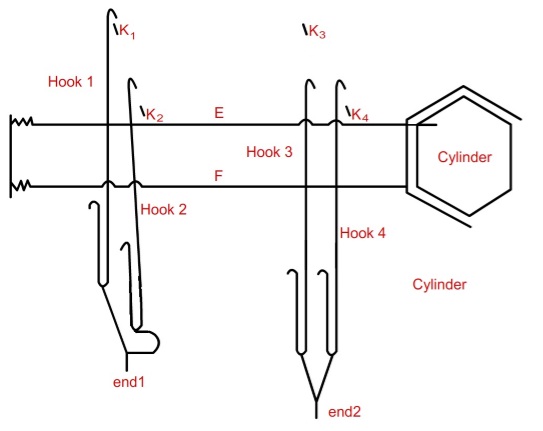
| Double- lift single-cylinder (DLSC) jacquard is shown in Figure 6.42. In this case, one end is controlled by two hooks which are again controlled by a single needle. For example, hooks 1 and 2 control the end 1 and hooks 3 and 4 control the end 2. Two sets of knives are used in DLSC jacquard and they move up and down (rise and fall) in complete phase difference i.e. when one set of knives (K1 and K3) attain the highest position, the other set of knives (K2 and K4) attain the lowest position. At the given position, end 1 has been raised as the hook 1 has been lifted by the corresponding knife K1. However, end 2 has not been raised as hook 3 was not caught by the knife K3. In the next pick, end 1 will be lowered as the needle F has been pressed towards the left due to the absence of a hole in the punch card. So, hook 2 has become tilted and it will not be raised by the knife K2 when the latter will rise. Hook 1 will also descend along with Knife K1. Thus the end 1 will be lowered. On the other hand, end 2 will be raised in the next pick as there is a hole in the punch card corresponding to the position of the needle E. So, hook 4 is upright and it will be caught by knife K4
when the latter will move upward. |
|
| Figure 6.42: Side view of double-lift single-cylinder jacquard |
In case of DLSC jacquard, if the loom speed is 300 picks per minute then the cylinder will turn 300 times per minute but the knives will reciprocate (rise and fall) 150 times per minute. This is the advantage of DLSC jacquard over SLSC jacquard. |
| DLDC jacquard produces semi open shed because if a particular end has to be in raised position for two consecutive pick, it will descend up to the middle point of its vertical path and then move up. This will happen because one of the hooks will descend and the other hook will move up with their respective knives and they will cross at the middle of their vertical path. If the end has to remain in bottom position for two consecutive picks, it will remain at the bottom without any intermediate movement.
|
Features of DLSC Jacquard |
- 500 end machine will have 500 needle and 1000 hooks
- Two sets of knives rise and fall in opposite phase
- Cycles of movement (rise and fall) of each set of knives spans over two picks
- Cylinder should turn in every pick
- Semi open shed is produced
|
Double-Lift Double-Cylinder (DLDC) Jacquard
|
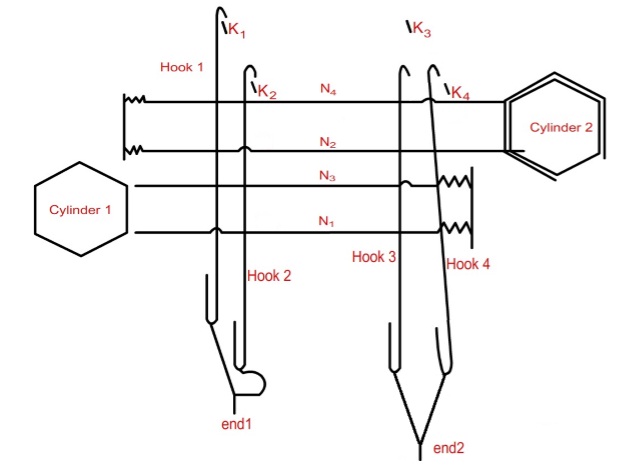
| Figure 6.43 depicts the double-lift double-cylinder (DLDC) jacquard. In case of (DLDC) jacquard, the number of cylinder rotation or turn and number of reciprocation cycle of knives is half as compared to that of SLSC. In this case, one end is controlled by two hooks as it was in case of DLSC. However, each of the hooks is controlled by separate needles. Hooks 1 and 2 control the end 1 and hooks 3 and 4 control the end 2. Needles 1, 2, 3, and 4 control the hooks 1, 2, 3 and 4 respectively. The two needles (say N1 and N2) corresponding to a particular end (say end 1) are controlled by two cylinders in two picks. One of the needles (N2) is controlled by the right cylinder (cylinder 2) and the other needle (N1) is controlled by the left cylinder (cylinder 1). One cylinder carries the punch cards for even pick numbers like N, N+2, N+4, N+6 and so on. Here N is an even number. The other cylinder carries the punch cards for odd pick numbers like N+1, N+3, N+5 and so on. In one pick, either of the two cylinders performs the selection operation. DLDC jacquard is capable to handle the maximum loom speed (picks per minute) among the three types of jacquard.
|
Figure 6.43 shows that end 1 is in raised position and end 2 is in lowered position in this current pick. End 1 will continue to be in raised position in the next pick as there is a hole in punch card on cylinder 2 corresponding to the position of needle 2 (N2). So, hook 2 will remain in upright position and thus it will be raised by the knife 2 (K2). On the other hand, end 2 will continue to be in lowered position as it is being tilted by needle 4 (N4) as there is no hole on cylinder 2 corresponding to the position of N4. So, knife 4 (K4) will miss the N4 when the former will rise in the next pick.
|
|
Figure 6.43: Side view of double-lift double-cylinder jacquard
|
Features of DLDC Jacquard |
-
500 end machine will have 1000 needles and 1000 hooks
-
Two sets of knives rise and fall in opposite phase
-
Cycles of movement (rise and fall) of each set of knives spans over two picks
-
Cylinder should turn in alternate pick
-
Semi open shed is produce
|
Jacquard Harness
|
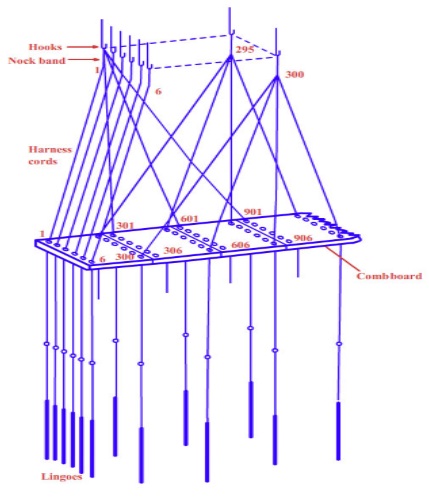
It is the system by which the ends are controlled during jacquard shedding with the help of nylon cords, heddles (heald eyes) and dead weights (lingoes). In the preceding part of discussion, it has been considered that the capacity of jacquard is 300 ends. Now, if the fabric has 3000 ends then ten repeats of the design can be produced on the fabric. For example, if a floral pattern is woven on the fabric and it requires 300 ends, then 10 such floral patterns can be produced on the entire width of the fabric. It is assumed that the hooks of the jacquard are arranged in six rows and each row is having 50 hooks. Then each hook will effectively control 10 (3000/300) ends. The interlacement pattern of end 1, 301, 601, 901, 1201, 1501…….2701 will be identical and thus they can be controlled by hook no. 1 through 10 nylon cords. Similarly, hook no. 300 will control 10 ends namely end number 300, 600, 900, 1200, 1500, 1800, ….., 3000. This has been depicted in Figure 6.44. The individual harness cords pass through the perforations of a wooden or polymer board named comber board. The dead weights or lingoes pull the end downwards when it is not lifted.
|
|
| Figure 6.44: Jacquard harness |
Problems in Jacquard Harness in Case of Wide Looms
|
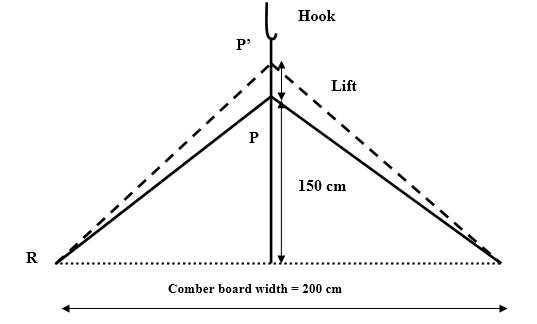
When the loom width and thus the comber board width are high, problem may arise in terms of variation in the lift received by various heddles and consequently the warp ends they control. This will be clear from the Figure 6.45. Here the loom width is 200 cm and the perpendicular distance between the neck band suspended from a hook and the comber board is 150 cm when the end is down. The lift of the hook is 10 cm. |
|
| Figure 6.45: Variation in Jacquard lift
|
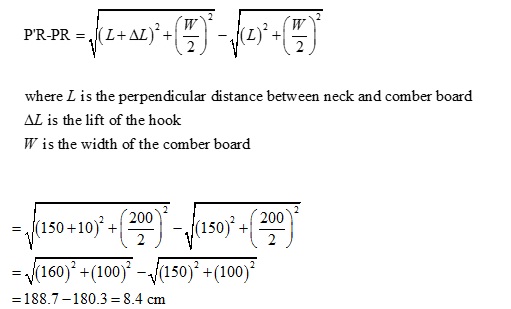
Therefore, when the hook is raised by 10 cm, then the heddle which is exactly at bottom of the hook will receive a lift of 10 cm. However, the heddle which is at the extreme left or right of the comber board will receive a lift equal to the following.
|
|
Thus the loss of lift is around 16% with respect to the warp end positioned vertically below the hook.
|
Electronic Jacquard
|
In recent times electronic jacquards have become very popular. It controls the ends by synchronized operations of following machine components.
|
- Electromagnet
- Retaining hook or ratchet
- Hooks
- Knives
- Double roller
|
| The knives are used to lift or lower the hooks. If the electromagnet is activated by the signal pattern, then it can briefly retain the upper end of the retaining hook once the latter is pressed on the electromagnet due to the upward movement of the hook. If this happens then the hook is not retained by the retaining hook when the former starts to descend with the knife. On the other hand, if the electromagnet is not activated, then the hook is retained or caught by the retaining hook.
|
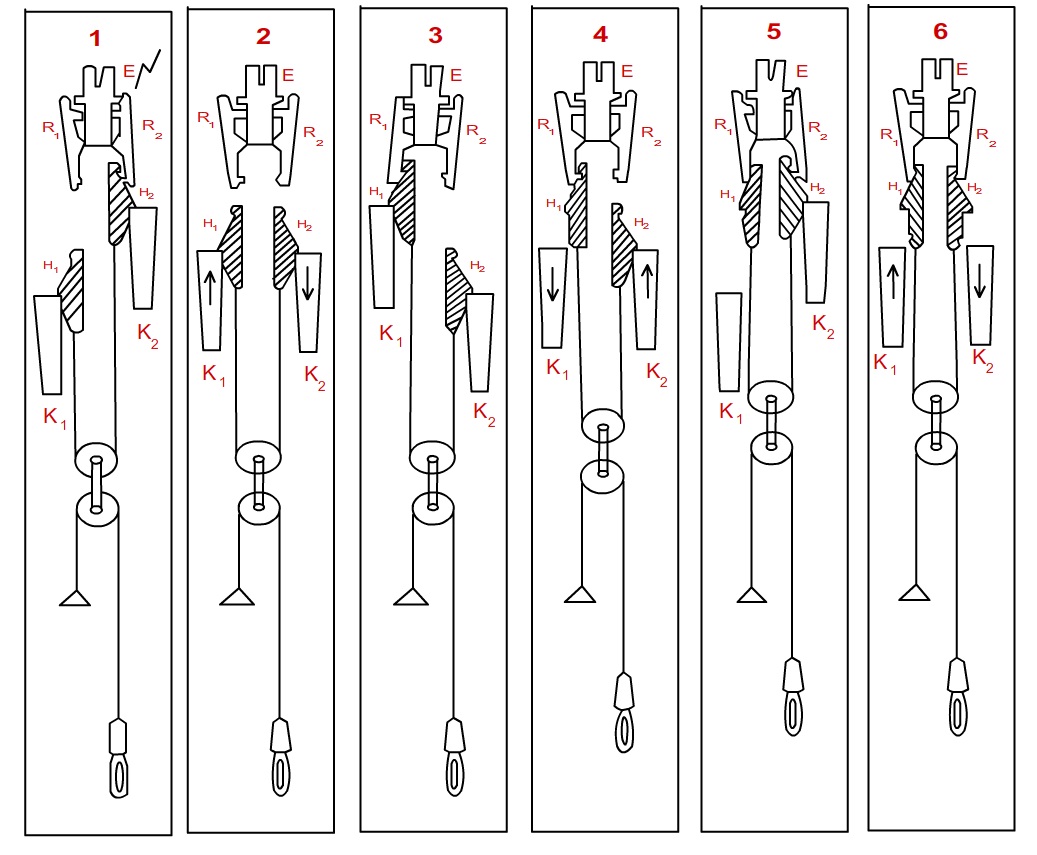
Figure 6.46 depicts the operation of the electronic jacquard system.
|
Position 1: Hook 2 (H2) has been lifted to the highest position by the knife 2 (K2). However, the electromagnet (E) has been activated and it holds the top end of the retaining hook 2 (R2) momentarily and thus ensures that the retaining hook 2 does not catch the hook 2 when the latter is descending. At this instance the shed is at lower position.
|
Position 2: Knife 2 and hook 2 are descending whereas knife 1 (K1) and hook 1 (H1) are moving up. So there is no effective movement of the double pulley assembly or shed. The shed is still at lower position. |
Position 3: The hook 1 has been raised to the highest position by the knife 1 and thus the hook 1 has pressed the top end of retaining hook 1 (R1) against the electromagnet. At this moment the electromagnet has not been activated which ensures that the kook 1 is caught by the retaining hook 1.
|
Position 4: Knife 1 has started to descend but the hook 1 cannot descend as it is caught by the retaining hook 1. Knife 2 has again started its upward movement along with hook 2. The shed has now started to change its position (moving upward). This is because the hook 1 is already in raised position (caught by retaining hook 1) and hook 2 is also moving up. |
Position 5: The hook 2 has pressed the top end of retaining hook 2 against the electromagnet which is not activated as this instance. Thus hook 2 is caught by the retaining hook 2. As both the hooks are now in raised position, it creates upper shed position. |
Position 6: Knife 2 has started to descend. However, the hook 2 retains its raised position as it is held by the retaining hook 2. Thus the shed remains in upper position. |
|
Figure 6.46: Principles of operation of electronic jacquard |