| Fabric weave design implies the pattern of interlacement between the warp and weft yarns. The design influences the aesthetics as well as the properties of the woven fabrics. The design of woven fabrics is manipulated by changing the following two things.
|
| |
| The design is constructed on point paper by using cross (×) and blank. The cross means that the end is passing over the pick. The blank means the end is passing below the pick.
|
| Drafting |
Drafting determines the allocation of ends to healds i.e. which end will be controlled by which heald. Generally, drafting is made in such a way that minimum number of healds is required to produce a particular design. This implies that if the interlacement pattern of two ends is identical then they should be controlled by the same heald shaft. In case of drafting, a cross means that the heald is up and a blank means that the heald is down. |
| Drafting is shown above the weave design. |
Lifting Plan
|
Lifting plan shows the position of healds (up or down) for different peaks i.e. which heald or healds will be lifted in which pick. It is dependent on the design and the drafting.
|
| Lifting plan is shown at the right hand side of weave design. |
Straight Draft
|
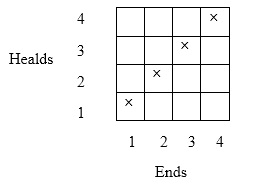
| In case of straight draft, a diagonal line is created by the crosses (Figure 5.1). This implies that, generally, end one is controlled by heald one, end two is controlled by heald two and so on. |
|
Figure 5.1: Straight draft
|
| Pointed Draft
|
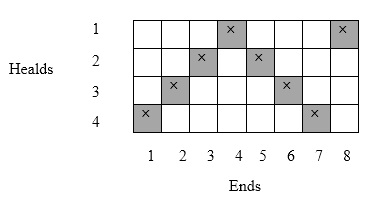
In case of pointed draft, a pointed line is created by the crosses (Figure 5.2). The repeat of the design contains more than one ends with similar interlacement pattern. For example, in Figure 5.2, the interlacement pattern is same for ends 1 and 7 and thus they are allocated to one heald (heald number 1). It is also true for ends 2 and 6, 3 and 5, 4 and 8. Therefore, this design which is having eight ends in the repeat requires only four healds. Pointed twill weaves are made using pointed draft.
|
|
Figure 5.2: Pointed draft
|
| Skip Draft
|
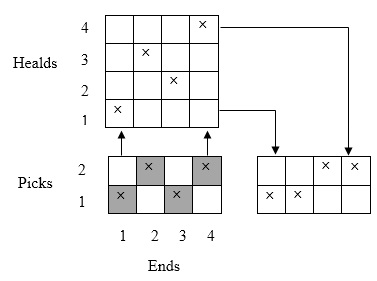
In case of skip draft, two or more healds are controlled by a single shedding cam. Plain woven fabrics can be woven with two healds. However, for heavy (high areal density) plain woven fabrics, the number of ends is very high. It often becomes convenient to use four healds for the heavy plain woven fabrics. Therefore, the number of ends controlled by a single heald becomes less as compared to the situation with only two healds. The skip draft for plain woven fabrics with four healds is shown in Figure 5.3.
|
|
|
The allocation of healds is shown in Table 5.1. |
Table 5.1: Assigning ends in healds for skip draft |
| End number |
Heald number |
1 |
1 |
2 |
3 |
3 |
2 |
4 |
4 |
|
So, the allocation of healds for ends 2 and 3 differs from that of straight draft. Lifting plan shows that for the 1 st pick, healds 1 and 2 are in up position and healds 3 and 4 are in down position. For pick 2, healds 1 and 2 are in down position and healds 3 and 4 are in up position. Therefore, the movement pattern of healds 3 and 4 is just opposite as compared to that of healds 1 and 2. Therefore, healds 1 and 2 can be tied or coupled together with ropes or strings and their shedding operation can be controlled by a single cam. Similarly, shedding operation of healds 3 and 4 can be controlled by another cam. Thus, skip drafting helps to reduce the number of mechanical components (cam, follower, treadle lever etc.) in the loom. |
Simple Weaves |
The following weaves are the most popular in woven fabrics. |
- Plain weave and its derivatives
- Twill weave
- Satin and Sateen weave
|
Plain Weave |
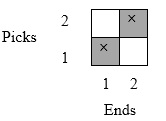
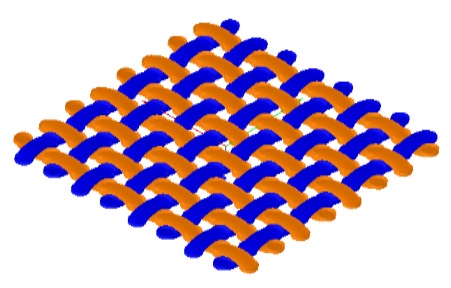
It is the simplest possible and most commonly used weave. The repeat size is 2×2 as depicted in Figure 5.4. That implies that the weave repeats on two ends and two picks. It gives maximum number of interlacement in the fabric and therefore the fabric becomes very firm. As the yarns are having maximum possible interlacements, the crimp in the yarns is also higher as compared to other weaves. Figure 5.5 depicts the interlacement pattern in a plain woven fabric. |
|
Figure 5.4: Point paper representation of plain weave |
|
Figure 5.5: Interlacement pattern of plain weave (warp: orange and weft: blue) |
Derivatives of Plain Weave |
Warp rib, weft rib and matt (basket) weaves are the derivatives of plain weave. All these designs can be woven with two healds. |
Warp Rib |
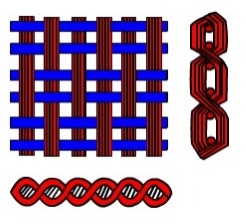
In case of warp rib, two neighbouring picks move in a group as shown in Figure 5.6. Prominent ribs become visible in the warp direction of the fabrics which is created by the floats of the ends. The picks undergo more number of interlacement than the ends and therefore the crimp in the weft yarns is higher than that of warp yarns. |
Due to the interlacement pattern, warp rib will have more tearing strength in the warp direction as compared to the plain woven fabrics having similar yarns and threads per inch. For warp rib fabrics, two neighbouring picks will resist the tearing force together in a pair resulting in higher tearing strength in warp direction as compared to equivalent (same yarn and same threads per inch) plain woven fabrics. |
|
Figure 5.6: Interlacement pattern of warp rib |
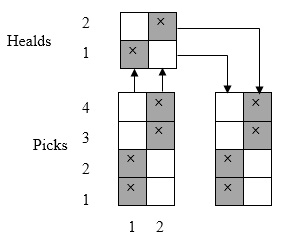
The design, drafting and lifting plains of warp rib is shown In Figure 5.7. |
|
Figure 5.7: Design, drafting and lifting plan of warp rib |
Weft Rib |
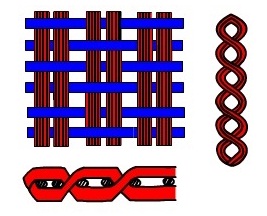
In case of weft rib, two neighbouring ends move in a group as shown in Figure 5.8. Prominent ribs become visible in the weft direction of the fabrics which are created by the floats of the picks. The ends undergo more number of interlacement than the picks and therefore the crimp in the warp yarns is higher than that of weft yarns. Weft rib will have more tearing strength in the weft direction as compared to the plain woven fabrics having similar yarns and threads per inch. |
|
Figure 5.8: Interlacement pattern of weft rib |
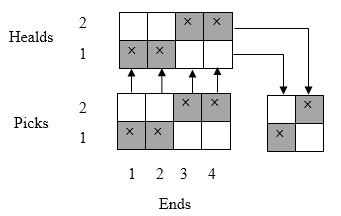
The design, drafting and lifting plains of weft rib is shown in Figure 5.9. |
|
Figure 5.9: Design, drafting and lifting plan of weft rib |
Matt or Basket Weave |
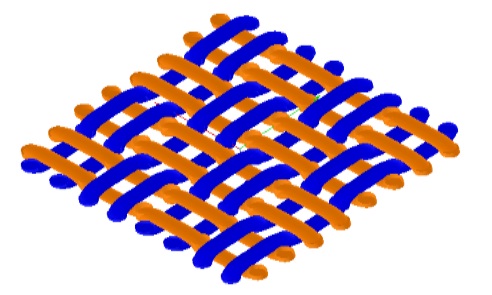
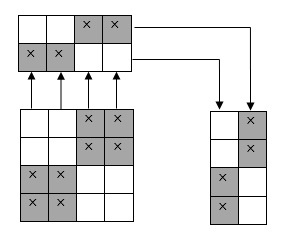
In matt weave, multiple ends and picks interlace with each other in a group. The number of interlacement in the fabric is much lower than that of plain weave. In 2×2 matt weave, two ends and two picks form pairs and interlace in the form of plain weave as shown in Figure 5.10. Therefore, the tearing strength of matt woven fabrics is higher in both directions as compared to that of equivalent plain woven fabrics. The design, drafting and lifting plains of 2×2 matt weave is shown in Figure 5.11. |
|
Figure 5.10: Interlacement pattern of 2×2matt weave (warp: orange and weft: blue) |
|
Figure 5.11: Design, drafting and lifting plan of 2×2matt weave |