| The objective of warp sizing is to improve the weaveability of yarns by applying a uniform coating on the yarn surface so that protruding hairs are laid on the yarn surface.
|
| During the weaving process, the warp yarns are subjected to abrasion with various loom components like back rest, heald eyes, reed, front rest etc. In shedding operation, warp yarns also abrade against each other. Size coating protects the yarn structure from abrasion. Therefore, the warp breakage rate in the loom reduces
|
| Benefits of Sizing |
- It prevents the warp yarn breakage due to abrasion with neighbouring yarns or with back rest, heald eye and reed.
- It improves the yarn strength by 10 to 20%, although it is not the primary objective of sizing process.
|
| Characteristics of Sized Yarn |
- Higher strength
- Lower elongation
- Higher bending rigidity
- Higher abrasion resistance
- Lower hairiness
- Lower frictional resistance
|
Definitions
|
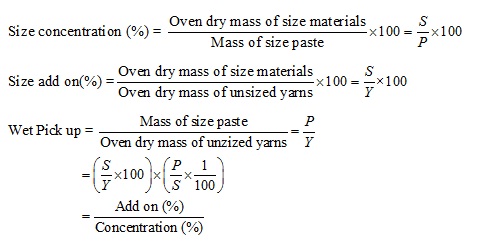
Size paste concentration, size pick-up and size add-on are some of the terms used frequently in the discussion of sizing process. They are defined as follows:
|
|
Sizing-weaving Curve
|
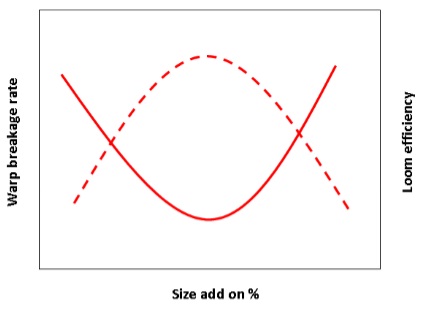
For the sizing process, depending on the size materials used, there is a target add-on for the optimum performance of the warp yarns in the weaving process. This can be understood from the sizing-weaving curve (Figure 4.1). The solid line represents the warp breakage rate whereas the broken line implies loom efficiency.
|
|
Figure 4.1: Sizing-weaving curve
|
| At very low level of size add-on, the yarn is not adequately covered by the size film and therefore the yarn is not protected from the abrasion with various loom parts. So, warp breakage rate is generally high at very low level of size add-on. The performance of the yarn in weaving improves as the size add-on increases. The optimum add-on level is marked by very low level of warp breakage rate. However, if the size add-on is higher than the optimum level then warp breakage rate increases again largely due to the loss of elongation and increase in bending rigidity of the yarns. |
The optimum level of size add-on will depend on the following factors: |
- Type of fibre
- Type of size materials
- Yarn spinning technology
- Yarn count and twist
- Level of hairiness in the yarn
- Loom type and loom speed
|
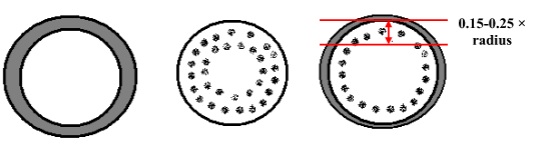
Although add-on primarily influences the weaving performance, it is possible to have different weaving performances even at the same level of size add-on. This can happen due to differences in (a) Size penetration and (b) Size coating or encapsulation. This can be explained from the Figure 4.2.
|
|
Figure 4.2: Size coating or encapsulation, size penetration and optimum coating and penetration |
| In the first case, the size material has formed a uniform coating on the yarn surface. But the penetration of the size material is in adequate. This may tackle the hairiness problem. However, the adhesion of the size film with the yarn will be lower. The size coating will also be very stiff. Therefore, during the abrasion with various machine parts and neighbouring yarns, the size will fall (shed) and thus the weaving performance will be poor. |
In the second case, the coating or encapsulation on the yarn surface is inadequate. Therefore, the yarn will not get adequate protection against the abrasion. Besides, the size materials have penetrated too much inside the yarn which is not desirable. |
The third case is the optimum one where there is a thin but uniform coating formation on the yarn surface by the size materials. Moreover, the size materials have also penetrated to some extent in the yarn structure which ensures good adhesion between the yarn and the size coating. For optimum weaving performance, size should penetrate to a distance equal to 15-25% of yarn radius. |
|
|
|