-
So far we made the following assumptions:
- Band structures are not disturbed by the doping
- Band structures are still represented as ( so called) parabolic
- Dopants are independent from each other
- Dopants levels are low
It is also to be noted that the donors (or acceptors) energy levels are assumed as atom like. Such assumptions are limited up to to a certain level of dopant concentration and such extrinsic semiconductors are called non-degenerate semiconductors.
What happens if we add dopants at much higher concentrations? Dopant atoms come much closer to each other and it is no longer valid to assume the donor levels as atom like. If the inter-atomic distance is closer (typically < 10nm) then the atomic levels turn into bands. This leads to significant changes in the crystal structure as well as the physical properties. Another very important effect is, highly doped semiconductors come to freeze-out at much lower temperatures, meaning the freeze-out region is almost eliminated!. Such highly doped semiconductors are called Degenerate semiconductors.
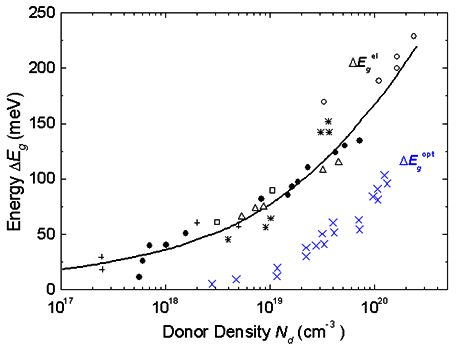
Fig.2.32.Effect if band gap (both electrical (ΔEel) and as well as optical (ΔEopt) )
change in heavily doped Silicon.
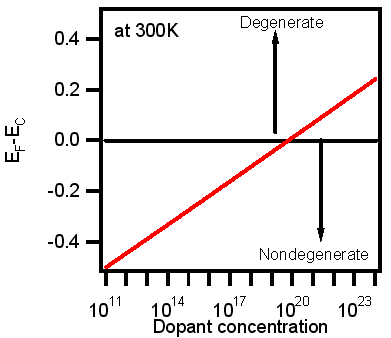
Fig. 2.33. Effect of dopant ( donor) concentration on Fermi level position,
with respect to conduction band in silicon.