| |
For ideal metals, the thermal
conductivity due to electrons is given by     where is the mean square electronic speed, is the
relaxation time, and is the specific heat capacity of the
electrons. The ratio of the thermal conductivity  to the
electrical conductivity times temperature (  T) of an
electron gas is a universal constant (Lorentz number) and this is
called Wiedmann-Franz law. The value of the Lorentz number is of the
order of 
 in typical metals. |
| Heat capacity |
The temperature dependence of the specific heat capacity of an electron
gas is given by
 where  is the Boltzmann constant and  is
the density-of-states at the Fermi level. The value of  in
typical metals is of the order of 1  .
In the Debye model, the phonon contribution to the heat capacity per
atom is given by 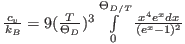 where  is the Debye temperature. |
|
|
|

