|
|
||
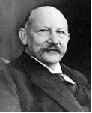
| Heike Kamerlingh Onnes was born on September 21, 1853, at Groningen, The Netherlands. In his professional life, he established a cryogenic laboratory at Leyden. His intention was to do research to probe the theories of J.D. van der Waals and H.A. Lorentz. By his technical efforts, he was able to liquify helium gas (this happens at 4.2 K) and further bring down the temperature of helium to as low as 0.9 K. Simultaneously with this, he used the apparatus built in his lab to investigate the properties of matter at low temperaure. This led him, in 1911, to the discovery of superconductivity in mercury at 4.2K. The reason for choosing mercury as the first element to be investigated was that it was possible to purify mercury to a great extent using distillation techniques at room temperature (it was felt that impurities significantly affected the low-temperature properties of materials). Onnes was assisted by Gerrit Flim who was the chief of the technical staff in the lab. In addition, experiments were performed by co-workers Gilles Holst and Cornelius Dorsman. Onnes and Flim looked after the cryogenic apparatus in which the mercury was cooled, while Holst and Dorsman sat in a dark room 50 meters away, recording the readings of a galvanometer. Subsequently, he discovered superconductivity (he called it supraconductivity at that time) in other metals such as tin and lead. He was awarded the Nobel prize in Physics in 1913. | ||