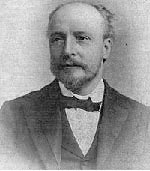
Sir James Dewar FRS was born on 20 September 1842 and he died on 27 March 1923. He was a Scottish chemist and physicist and is perhaps best-known today for his invention of the Dewar flask (which is used to store cryogenic liquids for long periods, without significant loss from evaporation). He invented this in connection with his research into the liquefaction of gases.
His name is most widely known in connection with his work on the liquefaction of the so-called permanent gases and his researches at temperatures approaching absolute zero. He was deeply interested in exploring the properties of "liquid gases''. He demonstrated the working of a Cailletet apparatus which was used to liquify gases. He also built a machine from which the liquefied gas could be drawn off through a valve for use as a cooling agent. He was also able to obtain oxygen in the solid state.
By 1891 he had designed and built machinery which yielded liquid oxygen in industrial quantities. He also eventually showed that both liquid oxygen and liquid ozone are strongly attracted by a magnet. Unfortunately, Dewar did not profit from the widespread adoption of his vacuum flask since he lost a court case against Thermos concerning the patent for his invention. Since Dewar did not patent his invention, it was possible for Thermos to use his design though was recognised as the inventor.
He also experimented with a high pressure hydrogen jet by which low temperatures were realized through the Joule\textendash{}Thomson effect. Using this technique, he built a large regenerative cooling refrigerating machine. Using this machine in 1898, liquid hydrogen was collected for the first time, solid hydrogen following in 1899. One of his ultimate goals was to liquefy the last remaining gas, Helium. Unfortunately, among other factors, he did not have an adequate supply of Helium gas with which to work. Dewar was preceded by Heike Kamerlingh Onnes as the first person to produce liquid helium, in 1908. Onnes was awarded the Nobel Prize in Physics for his research into the properties of matter at low temperatures. On the other hand, Dewar was nominated several times but was never successful in winning the Nobel Prize.