with  being an integer. But the observation is that the pattern
remains unchanged when the intensity of the beam is varied, indeed
the same pattern is observed even when the particles appear only
one at a time. This of course implies that the wave properties are
associated with the particles, and the intensity implies a
statistical probability for the particle to be observed at various
positions. being an integer. But the observation is that the pattern
remains unchanged when the intensity of the beam is varied, indeed
the same pattern is observed even when the particles appear only
one at a time. This of course implies that the wave properties are
associated with the particles, and the intensity implies a
statistical probability for the particle to be observed at various
positions.
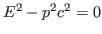
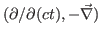
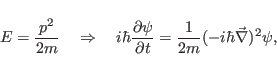
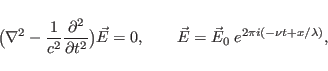
For developing general wave equations for particles, one
observes that we have the wave equation and wave function for
radiation which we can associate with photon particles. For the
radiation one has
|



![$\displaystyle \Rightarrow\big[\big(i\hbar\frac{\partial}{\partial t}\big)^2
-c^2\big(-i\hbar\vec \nabla\big)^2\big]\vec E_0e^{i(-Et+px)/\hbar}=0.$](../../images/img289.png)